This blog collects the journalism of John Stapleton from the 1970s to the present day.
Monday, 19 August 2002
Friday, 16 August 2002
Trend to big farms likely to continue, The Australian, 16 August, 2002.
Trend to big farms likely to continue: [1 Edition]
Stapleton, John. The Australian [Canberra, A.C.T] 16 Aug 2002: 26.
Show highlighting
Abstract
Over the past 40 years, the number of commercial farms in Australia has almost halved, from around 200,000 in 1961 to just over 100,000 in 2001. At the same time, the average area of land operated by these broadacre farms has increased almost 50 per cent from 2800ha to about 4100.
The number of farms purchasing or leasing additional land in 2000- 01 has increased to its highest level since ABARE started surveying broadacre farms in 1977. Not just larger farms are expanding. ABARE survey data indicates farms of all sizes are acquiring land. The extra land typically represents expansion of 13 per cent to 30 per cent of the farm's size.
* Rural
GET big, get tough or die -- that's what farmers were told in the 1980s. However, with government forecasts suggesting that weaker prices and lower returns will lead to tough times, questions are being asked about whether or not the "get big or get out" rule is still appropriate.
Over the past 40 years, the number of commercial farms in Australia has almost halved, from around 200,000 in 1961 to just over 100,000 in 2001. At the same time, the average area of land operated by these broadacre farms has increased almost 50 per cent from 2800ha to about 4100.
But the country is littered with tragic tales of families who lost everything after following advice from government bureaucracies, aided and abetted by free-wheeling banks.
In a recent paper, "Get Big or Get Out: Is the mantra still appropriate for the new century", statisticians at the Australian Bureau of Agriculture and Resource Economics note that many Australian farmers who chose to get bigger, buying the farm next door or otherwise expanding their operations, were caught by astronomically high interest rates and falling grain prices. Many farms were left with high debt, low equity and poor debt-servicing capacity.
"It was the beginning of the end for some of these businesses," it notes. "Many of the debt problems faced by farm business in the 1990s originated from farm expansion in the 1980s."
But ABARE executive director Brian Fisher said the trend towards larger farms was likely to continue.
"The largest third of commercial farm businesses have consistently achieved higher rates of return to capital than the smallest third, with the gap between them having increased over the past decade," he said.
The number of farms purchasing or leasing additional land in 2000- 01 has increased to its highest level since ABARE started surveying broadacre farms in 1977. Not just larger farms are expanding. ABARE survey data indicates farms of all sizes are acquiring land. The extra land typically represents expansion of 13 per cent to 30 per cent of the farm's size.
During 2000-01, a record number of beef producers acquired more land and expanded their enterprises. The beef industry has been a star, with last financial year's farm cash income for beef producers estimated to have increased 36 per cent on the previous year.
Peter Martin, co-author of the paper "Get Big or Get Out", said the increasing size of farms did not mean the death of the family farm, with 99 per cent of farms family owned.
"It is not the being big that sends you broke. It is the getting there," he said.
Chief executive of NSW Farmers Jonathan McKeown called for a change to the Trade Practices Act to allow smaller properties to bargain collectively, presently illegal as being a so-called collusion on price. The move would make the vast majority of smaller operators who sustained farming communities more viable.
Wednesday, 14 August 2002
Questions for Larry Anthony over the Child Support Agency and related Death Toll, The Australian, 14 August, 2002.
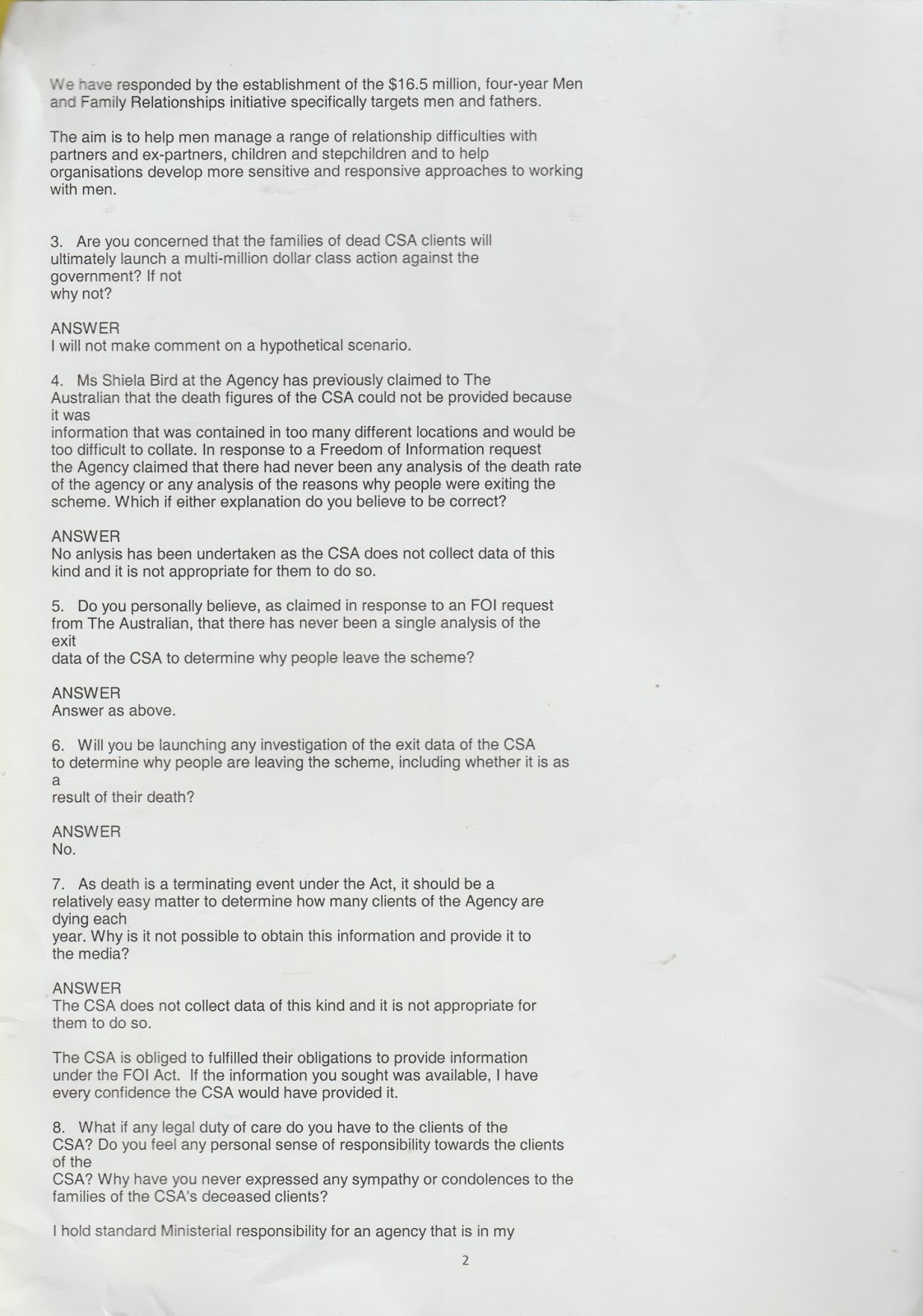
The direct link between the ruthless bureaucratic harassment of separated fathers by the Australian Child Support Agency remains one of the greatest scandals of Australian public administration. Concerned about the female vote and saddled with an administration bred on cultural Marxism, successive politicians have done nothing about it. This was part of an exercise to establish whether the claim by men's groups that three fathers a day were dying as a result of the CSA was true or false. After almost a year, including FOI requests, it finally emerged that 12 of CSA's clients were dying every day, about 2.5 times what you would expect in a similar aged cohort in the broader community. I had a great deal of trouble interesting the paper in this story, who did not in any way wish to face the ire of the women's movement or be seen to be un-progressive, a bit of a joke for a newspaper regularly lampooned as "right wing". The project eventually morphed into this front page story:
https://thejournalismofjohnstapleton.blogspot.com.au/2016/05/child-agency-ignored-threats-p1.html
Monday, 12 August 2002
Wednesday, 7 August 2002
Child Support Agency Death Toll, The Australian, 7 August, 2002.
This story eventually morphed into this front page story:
https://thejournalismofjohnstapleton.blogspot.com.au/2016/05/child-agency-ignored-threats-p1.html
There were many drafts along the way:
https://thejournalismofjohnstapleton.blogspot.com.au/2002/02/the-child-support-agency-disastrously.html
The link between the Australian Child Support Agency and the high death rates and poor outcomes for separated parents, most particularly but not always fathers, is undeniable.
The CSA remains a disgrace to the Australian Public Service.
https://thejournalismofjohnstapleton.blogspot.com.au/2016/05/child-agency-ignored-threats-p1.html
There were many drafts along the way:
https://thejournalismofjohnstapleton.blogspot.com.au/2002/02/the-child-support-agency-disastrously.html
The link between the Australian Child Support Agency and the high death rates and poor outcomes for separated parents, most particularly but not always fathers, is undeniable.
The CSA remains a disgrace to the Australian Public Service.
Monday, 5 August 2002
Friday, 2 August 2002
Picturesque and productive, The Australian, 2 August, 2002
Picturesque and productive: [1 Edition]
Stapleton, John. The Australian [Canberra, A.C.T] 02 Aug 2002: 24.
Show highlighting
Abstract
The first owners of Swatchfield, the Stevensons, were renowned for the quality of their Clydesdales, which were sold in Dubbo and were one of the bases of the Australian wheat industry prior to mechanisation.
[William Kater] was only two when his father bought Swatchfield in 1936.
He says he remembers his father's determined search for a good quality property. "He had the choice of everything, looked at many and picked Swatchfield," Mr Kater recalls.
* Rural
FORTY-five years ago this week, the then Australian cross- country ski champion William Kater met a Swiss girl Rosemarie, also an ardent skier.
Within a short time they were married.
They spent their life together at historic Swatchfield, regarded as one of the best rural properties in NSW.
Now approaching their 70s, they have reluctantly decided to sell, putting the 1027ha property on the market for $4.2 million.
It is the first time since 1936 that the property has been on the market. Swatchfield has only had three owners since it was first settled in the mid-1820s.
Three hours' drive from Sydney on the western side of the Blue Mountains, Swatchfield is not only regarded as a fine agricultural holding but is remarkably picturesque, scattered with stands of trees and sparked in autumn with the yellow glow of poplars.
The first owners of Swatchfield, the Stevensons, were renowned for the quality of their Clydesdales, which were sold in Dubbo and were one of the bases of the Australian wheat industry prior to mechanisation.
Descendants of the Stevensons can still be found around Dubbo.
"They bred very good Clydesdales," says William Kater. "The country has the heart in it to breed good constitutioned animals."
William Kater was only two when his father bought Swatchfield in 1936.
He says he remembers his father's determined search for a good quality property. "He had the choice of everything, looked at many and picked Swatchfield," Mr Kater recalls.
It was purchased from the Hackney family, large land owners in the Bathurst Oberon district who had acquired the property during World War I.
And it was William's father Henry who built the Kenneth McConnell- designed five bedroom country homestead. McConnell was the architect of choice for thesquattocracy during the 1920s and 1930s.
It boasts a formal sitting and dining room and a large provincial style manor hall with central stone fireplace. These days it's all centrally heated.
"It is a beautiful homey home," Kater says. "We both love it, it is absolutely charming. That's what makes the heart bleed, to leave it."
The homestead is set in an English garden with mature oaks, elms, birches, poplars, sweeping lawns and attractive stone walls and hedges.
Swatchfield also boasts some of the best trout fishing close to Sydney, with the district's best fishing hole only minutes from the homestead.
The Kater family have always bred egelabra or Spanish merino sheep, and there is a flock on the property.
Mrs Kater has also bred pure white South Suffolk sheep. The traditional South Suffolk has a black face, ears and feet, but the Katers have bred the black out of them, the only such flock in the country.
The lack of black makes the sheep more effective for wool production on top of their traditional role as prime lambs.
There is also a herd of "very good Vern-blood Hereford cattle" on the property, acclimatised and well suited to the country.
All the animals are available for sale.
Although Mr Kater has been running the property on his own -- he says it can be run quite effectively by one 70-year-old gentleman such as himself -- there is ample accommodation if a manager is required.
There is a four-bedroom manager's residence and two other cottages, including a stone cottage dating back to 1863.
"It is a wonderful place, it should make someone who wants to buy it very happy," says Mr Kater sadly.
When pressed as to why he is selling something that obviously brings him so much pleasure, he says, "I don't know how old you are or how you feel at your age, but I'm nearly 70 and ..." He doesn't finish the sentence. He doesn't have to.
Illustration
Caption: Rare opportunity:Swatchfield has only had three owners since it was first settled in the mid-1820s; Photo: Photo
Monday, 29 July 2002
Thursday, 25 July 2002
Gatecrash subject charged, The Australian, 25 July, 2003.
Gatecrash suspect charged: [6 - NSW Country Edition]
Stapleton, John. The Australian; Canberra, A.C.T. [Canberra, A.C.T] 25 July 2003: 5.
Show highlighting
Abstract
A 22-YEAR-OLD man has been arrested after a six-week investigation into the party gatecrashing death of teenager Nathan Garriock.
Detectives tracked the 22-year-old man, who is believed to have been the driver of the car, to a property at Eatonsville near Grafton in northern NSW.
A 22-YEAR-OLD man has been arrested after a six-week investigation into the party gatecrashing death of teenager Nathan Garriock.
The 17-year-old was hit by a car alleged to have been deliberately driven into a crowd of people in the early hours of the morning outside a party in Sydney's west.
Garriock died in hospital from head and chest injuries after he and seven other people were hit by the car, which rammed into partygoers in the early hours of June 15.
He was also hit with a hard object during a melee with gatecrashers. The apprentice tiler, said to always have a smile on his face, loved his ute, his motorcycle and playing soccer.
His death received widespread coverage in Sydney and provoked considerable community outrage.
Detectives tracked the 22-year-old man, who is believed to have been the driver of the car, to a property at Eatonsville near Grafton in northern NSW.
The man will appear this morning in Grafton Local Court, where he will face multiple charges of assault, dangerous driving and driving while disqualified.
Police said it had been a difficult investigation, with about 150 people interviewed.
Monday, 22 July 2002
Friday, 19 July 2002
Seduced by a dell-ightful place in the country, The Australian, 19 July, 2002.
Seduced by a dell-ightful place in the country: [1 Edition]
Stapleton, John. The Australian [Canberra, A.C.T] 19 July 2002: 24.
Show highlighting
Abstract
If you live in Sydney and answered yes to both these questions, you may be interested in Cherry Dell, at Exeter outside Bowral on the Southern Highlands.
Cherry Dell is part of the break-up of Invergowrie, the 1937 estate of Australian Iron & Steel co-founder Sir Cecil Hoskins. It was built on the site of Headlands, the original Yates Seed and Bulb Farm.
Cherry Dell agent Duncan Hill, of Richardson & Wrench in Bowral, said there was a definite movement of people in their 30s and 40s to the Southern Highlands.
* Rural
FANCY a nice little weekender out of town -- but not too far out of town? Got a spare million or two?
If you live in Sydney and answered yes to both these questions, you may be interested in Cherry Dell, at Exeter outside Bowral on the Southern Highlands.
The newly listed 4.8ha property is for sale for $1.35 million.
These days that's starting to look like a pretty average price in the sought-after region.
Agents say it's now hard to find a one-acre property in Bowral for less than $800,000.
Cherry Dell is part of the break-up of Invergowrie, the 1937 estate of Australian Iron & Steel co-founder Sir Cecil Hoskins. It was built on the site of Headlands, the original Yates Seed and Bulb Farm.
One of Invergowrie's features was that much of the original Hoskins gardens was intact. They were designed by landscape gardener Paul Sorensen.
His legacy can be seen in the many mature trees, hedges and banks of daffodils that dot the former grounds.
Danish-born Sorensen came to Australia in the early part of last century, designing gardens for many leading families of the era. Everglades at Leura in the Blue Mountains is considered his greatest surviving work.
Invergowrie was bought in 1967 by solicitor Carnegie Fieldhouse. In 1997, the estate was subdivided, and Cherry Dell was created. Enter the Byrne family, who say they fell in love with it immediately.
The Byrnes are not among the "suits" -- stockbrokers, lawyers and pilots -- who have made Bowral such a sought-after spot for weekenders.
They're an example of the other demographic being drawn to the rural charms of the Southern Highlands -- families with young children who appreciate the safety and security of the region.
The Byrnes were living and working in Canberra when they discovered Cherry Dell.
"We think we got the best part of the Paul Sorensen gardens," says Amanda Byrne.
"Invergowrie has the main house and beautiful rhododendrons, but ours has a hidden valley, which is supposedly hand dug.
"We don't know if that's correct, but Paul Sorensen was against the use of heavy machinery, and it's possible.
"We just fell in love with Cherry Dell. The name comes from the hidden valley. It has a whole series of flowering cherries down through it -- lots of rhododendrons, masses of bulbs, and beautiful, mature trees, including golden elms."
Mrs Byrne said she found the area ideal for bringing up children, and can't speak highly enough of the local public school at Exeter.
And it takes only an hour for her husband to get to work in Nowra -- no more than many Sydney commuters face every day. Joanne Gowland, part-owner of the Bowral Property Group, said the local property market had completely turned around from a decade ago, when it was dominated by retirees.
"There is definitely a pick-up," she said. "People want bigger blocks, they want space, they want safety for thekids. People want to bring their kids up in less crime-ridden zones. They look to Bowral for these things. There are a lot of people escaping the stress of Sydney.
"The market for upmarket weekenders is strong, but families are taking over," Ms Gowland said.
"They're looking for the benefits of small-town life, without feeling they're removed from civilisation. People want mod cons, but they want to know their local shop-keepers at the same time."
Cherry Dell agent Duncan Hill, of Richardson & Wrench in Bowral, said there was a definite movement of people in their 30s and 40s to the Southern Highlands.
"They're people with money," he said. "They've invested in property and stock and done well. A home purchase from $1 million to $1.5 million is well within their range.
"The market for weekenders is usually older -- 50s to 60s. They have a house in Sydney's eastern or northern suburbs," he said. "Sometimes they're looking for a place which might suit them in retirement. Often they're just looking for seclusion and privacy."
Mr Hill said local papers were reporting an 11 per cent influx of people since the completion of the M5 motorway last year. The highway has significantly cut travelling times to Sydney.
"The comment you hear most often from buyers is that the hustle and bustle of Sydney is getting too much for them," he said.
"You can't go to the opera down here, but you can go to your local shop without having any hassle parking."
Illustration
Caption: Claim to fame:Cherry Dell is on the site of the original Yates seed and bulb farm, the Invergowrie estate; Photo: Photo
Subscribe to:
Posts (Atom)