Monday, 27 February 2017

Malcolm Turnbull looks to keep the prize seat of Wentworth in the family, The New Daily, 27 February, 2017.

http://thenewdaily.com.au/news/national/2017/02/27/malcom-turnbull-successor-james-brown/

Malcolm Turnbull looks to keep the prize seat of Wentworth in the family


Malcolm Turnbull's political future is becoming increasingly untenable, but he has a successor in mind. Photo: AAP
John Stapleton
SHARETWEETSHAREREDDITPINEMAILCOMMENT


With the latest dismal Newspoll, Malcolm Turnbull is now facing almost certain political death at the hands of either his own party or those of the electorate.

The question has now become not just who will take over the Liberal leadership, but who will take Mr Turnbull’s prized seat of Wentworth.

The PM’s son-in-law James Brown, a former army officer who has served in Iraq, Afghanistan and the Solomon Islands, is reportedly being groomed for preselection.

And the question is now one of when, not if, the seat of Wentworth becomes vacant.

Wentworth is the most glittering prize the Liberal Party has to offer. If Mr Brown inherits the seat, it will ensure that the inner-eastern Sydney seat remains within the orbit of the Turnbull family.

Wentworth is the wealthiest electorate in Australia, encompassing the elite suburbs of Vaucluse, Watsons Bay, Woollahra, Bellevue Hill and the Prime Minister’s own home turf of Point Piper. It has never been held by the ALP.
Related Coverage
Coalition’s own conservative ‘deplorables’ plot Malcolm Turnbull’s downfall

Tony Abbott to blame for shocking Newspoll: Malcolm Turnbull

Malcolm Turnbull plays the family card


While his critics see Mr Brown as ambitious, ruthless and out of touch with ordinary Australians – characteristics they also attribute to Mr Turnbull – others see a different man.

Moves by Mr Brown to cement his position for a tilt at Wentworth include taking the presidency of the Paddington branch of the Liberal Party in 2015. He rolled the sitting president, Peter Cavanagh, who told The New Daily he was aware of rumours Mr Brown is aiming to take the seat.

Although there was bad blood at the time, Mr Cavanagh insists there is now no ill will. “He is very competent,” he said. “I wish him well.”

Other manoeuvres by Mr Brown to boost his public image have included penning the book Anzac’s Long Shadow: The Cost of Our National Obsession and the more recent Quarterly Essay, Firing Line: Australia’s Path to War.

Both works place him on the opposite side of the Liberal Party to Tony Abbott, whose military interventions he has dismissed as a “chaotic” failure to understand Australia’s military.

Still other moves shoring up Mr Brown’s credibility for preselection including positioning himself to become the head of the NSW state branch of the RSL, which has been riven with scandal and accusations of financial mismanagement.

He paints himself as a clean skin who wishes to restore the RSL as “a force for good for veterans”.James Brown (L) is married to Malcolm Turnbull’s daughter Daisy. Photo: Facebook

Dr Norman Abjorensen, a leading political commentator whose many books include Australia: The State of Democracy, told The New Daily that, save for a miracle, Mr Turnbull was doomed. It was natural for him to be looking at his legacy and his successor.

“Turnbull is a very typical Wentworth product,” Dr Abjorensen said.

“It [Wentworth] is very strongly liberal, intellectual, Jewish. It has the highest concentration of gay people in the country. There is not much ground for social conservatism.”Mr Turnbull would prefer a successor like himself for the seat of Wentworth. Photo: Getty

Dr Abjorensen said a socially liberal, highly educated local candidate was needed to represent the seat.

“James Brown ticks all the boxes. And he has the added asset of being able to take on the Right by being a former military officer. He has crossover appeal,” he said.

“Malcolm Turnbull would prefer a successor like himself. He would want to keep a social liberal legacy going, not for his own sake, but for what he sees as the prevailing values in Wentworth he sought to represent.”

The New Daily’s repeated attempts to contact Mr Brown were not returned.

Wednesday, 22 February 2017

Benjamin Netanyahu looking to escape political heat in Israel, experts say, The New Daily, 22 February, 2017.


http://thenewdaily.com.au/news/world/2017/02/22/benjamin-netanyahu-visits-australia/


Benjamin Netanyahu looking to escape political heat in Israel, experts say


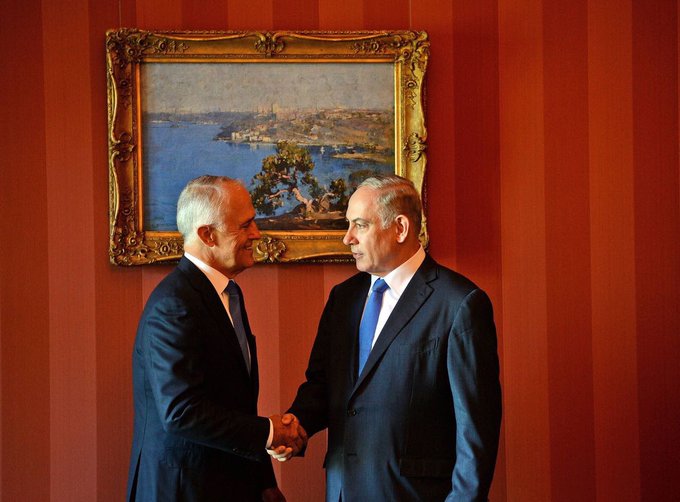
Benjamin Netanyahu and Malcolm Turnbull say their countries have an enduring friendship. Photo: AAP
John Stapleton
SHARETWEETSHAREREDDITPINEMAILCOMMENT


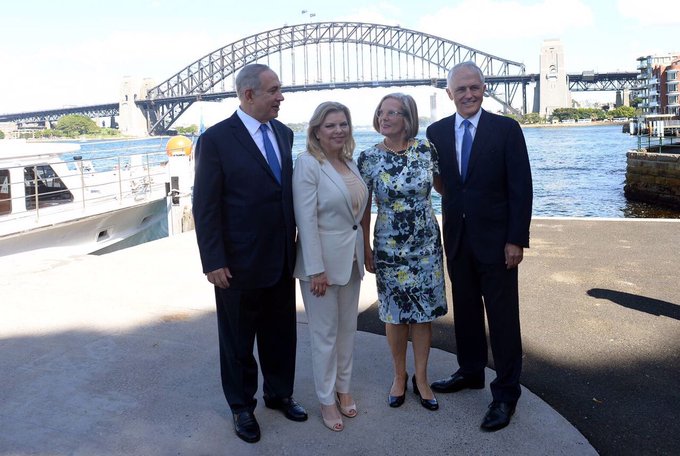
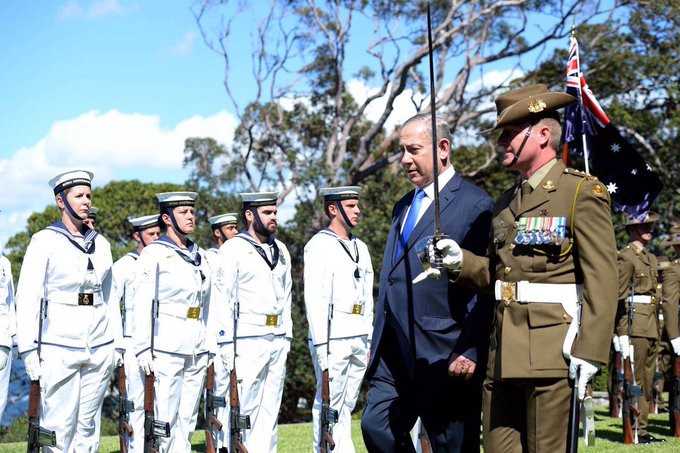
For all the backslapping over the enduring friendship between Israel and Australia, one thing has been overlooked: on the first visit of a sitting Israeli Prime Minister to Australia, Benjamin Netanyahu appears thoroughly delighted to be away from home.

Facing corruption allegations and having recently endured hours of humiliating interrogations by police amid talk his government is about to collapse, the warmth of his reception in Australia can only be a source of succour.

“We have so much in common, shared values, democracy, freedom, the rule of law,” Prime Minister Malcolm Turnbull declared on Wednesday. “Two great democracies … each of us big-hearted, generous, committed to freedom.”

But while Mr Turnbull was telling Mr Netanyahu just how welcome he was, back in Israel the talk is of just how much longer the latter can last as Prime Minister. Last month, investigators from the national police anti-fraud unit twice questioned Mr Netanyahu at his Jerusalem residence. He and his family stand accused of accepting thousands of dollars in inappropriate gifts from wealthy businessmen.

Israeli newspapers have reported that Australian billionaire James Packerprovided Mariah Carey tickets, private plane trips and expensive hotel stays to Mr Netanyahu’s son Yair.
Related Coverage
Benjamin Netanyahu praises Malcolm Turnbull for calling out UN hypocrisy

James Packer caught in Israeli PM Benjamin Netanyahu corruption inquiry


On Wednesday, asked about the corruption allegations, Mr Netanyahu declared: “Obviously I am not going to comment on details, but I will say that I think nothing will come of it because there is nothing there, except friendship, which is a good thing.”

Mr Turnbull, when asked if he was concerned over one of Australia’s most successful businessmen, Mr Packer, being caught up in the investigations, said: “Likewise, I can’t comment and won’t comment on an investigation of that kind, and really have nothing further to add to what the Prime Minister has said.”

Experts on the relationship between Australia and Israel suggest the timing of the visit is at the very least convenient.

Middle East expert at the University of NSW, Dr Anthony Billingsley, told The New Daily: “Without being too cynical, he is looking for a lull from the politics at home.

“He is being investigated for corruption. He comes to Australia, gives a few speeches, everyone says positive things and he goes away relaxed and refreshed. I see reports from Israel he will not last out the year.”


Follow

Benjamin Netanyahu
✔@netanyahu


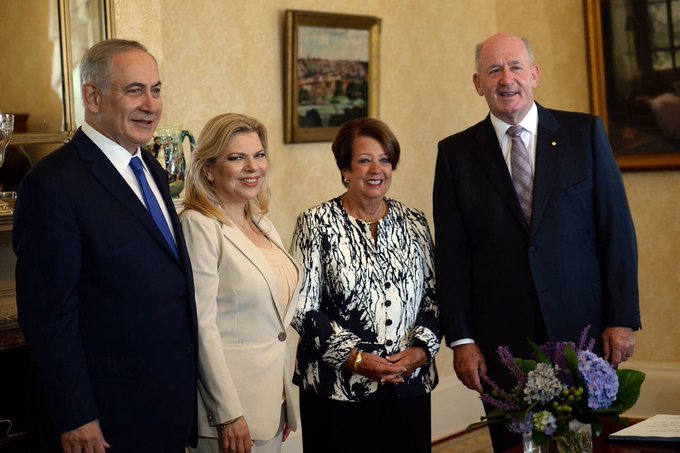
Great honor to be 1st Israeli PM to visit Australia. Met with PM @TurnbullMalcolm & Gov-Gen Peter Cosgrove – two great friends of Israel!
8:28 PM - 22 Feb 2017

376376 Retweets
1,8291,829 likes


Political scientist Shahar Burla, co-editor of the book Australia and Israel: A Diasporic, Cultural and Political Relationship, told The New Daily there were activists in Israel trying to have Mr Netanyahu replaced.

“He has spent a lot of time overseas in the last couple of months. He spent 20 hours last month with police officers, grilling him about corruption,” he said. “His political situation is not good.”

Mr Burla said Mr Netanyahu could be charged over an alleged gift he of about $300,000 from one individual, which would likely mean the end of his government.

Dr Billingsley said Mr Turnbull’s enthusiastic reception for Mr Netanyahu and for the state of Israel was driven in part by an attempt to expose divisions on the Israel/Palestine issue within the Labor Party.Benjamin Netanyahu, pictured at a luncheon in Sydney, and Malcolm Turnbull signed agreements on technology and air services. and also discussed expanding co-operation in areas including cyber-security, innovation and science. Photo: AAP

Head of the Australia-Israel Chamber of Commerce Michelle Blum disagreed, saying talk of Mr Netanyahu fleeing Down Under to escape political turmoil was ridiculous. He brought with him a delegation comprising 20 companies.

“He would hardly travel 24 hours to the other side of the world if there was a political problem at home. He would stay and deal with it,” she told The New Daily.

“The visit, long overdue, is a reflection of the strong relationship that has existed between Australia and Israel across the political spectrum. The business relationship is growing.”

Thursday, 16 February 2017

Why there might actually be method in Donald Trump's madness, The New Daily, 17 February, 2017.

http://thenewdaily.com.au/news/world/2017/02/16/method-in-donald-trumps-madness/

NEWS WORLD

Why there might actually be method in Donald Trump’s madness


Donald Trump, seen here with Israeli PM Benjamin Netanyahu, is flipping international diplomacy on its head. Photo: Getty
John Stapleton
SHARETWEETSHAREREDDITPINEMAILCOMMENT


There’s something to be said for a demolition expert.

Not content with reshaping America, US President Donald Trump is reshaping diplomacy throughout the world.

While the world’s diplomats are aflame with indignation over the seemingly ad hoc nature of Mr Trump’s foreign policy announcements, leading Australian policy experts suggest there could be a silver lining.

Mr Trump has called NATO obsolete, although it has been the bedrock of Western military alliance since World War II. He famously spoke on the phone to the Taiwanese President, throwing the One China policy up for grabs. He has been at clear odds with the Canadian Prime Minister Justin Trudeau, who has declared those fleeing war and terror will always be welcome in Canada. He is moving ahead with the wall between the US and Mexico, has jousted with the German leader and turned the relationship with Russia on its head.

On Thursday (AEST), he threw decades of diplomatic effort up in the air when he declared of the Palestine-Israel two-state solution: “I’m looking at two-state and one-state, and I like the one that both parties like.”
Related Coverage
Trump campaign aides had repeated contacts with Russian intelligence

Two state, One State, whatever … Trump re–writes US foreign policy on Israel

Donald Trump hits out at ‘fake media’, dodges press corps questions


Even in far-off Australia, he’s managed to insult Prime Minister “Trumble”.

One of Australia’s most experienced security advisers Allan Behm, author of the recent book No, Minister and former head of the International Policy and Strategy Divisions of the Department of Defence, argues that for all his iconoclastic bluster and rants against received wisdom, Mr Trump is forcing a re-examination of the alliances which have underpinned the West for 70 years.

“The best thing for friends and allies is they have had to review their position, and that is a good thing,” Mr Behm told The New Daily. “There is an upside when you have to test your fundamental assumptions. If the Prime Minister is going to get a bollocking every time he talks to the President, it is about time we thought about the alliance.”

What has upset much of the diplomatic and bureaucratic class worldwide – Mr Trump’s brazen contempt for established practice – is forcing America itself, along with its allies, to redefine exactly what their best interests are.

Professor of International Politics at the University of NSW Tony Burke told The New Daily the hostility or disdain between the Australian and US leaders was disturbing, “but if it makes us think about having an independent foreign policy, that is of benefit”.

“There has been a tendency to align too closely with Washington’s position on everything. We need to determine our own interests.”

Professor of History at the American University in Washington, Max Friedman, said of Mr Trump’s diplomatic efforts: “The most beautiful and classiest foreign policy ever”, before making it clear he was mimicking President Trump’s hyperbole.
The problem is we don’t know what Trump’s foreign policy is because he doesn’t seem to know.


“He has challenged convention without offering a coherent alternative. We don’t know if he values NATO or thinks it is obsolete. Is he recognising Taiwan or sticking with the One China policy? Does he support West Bank settlements or oppose them? He wants to obliterate ISIS, but is rattling sabres at Iran, the country doing the most to fight ISIS.”

Professor Rory Medcalf, head of the National Security College in Canberra, told The New Daily Mr Trump’s regular tweeting was compelling officials to invent policy on the run, all to fit in with his tweets.The US President hosted Japan PM Shinzo Abe last week. Photo: Getty

“That is unprecedented, that the most powerful man in the world has this way of circumventing his own system and the very, very powerful national security bureaucracy.”

But despite Mr Trump’s spectacular ability to ignore all traditional diplomatic practice, experts are united in thinking, or hoping, that the institutional strength and heavyweight machinery of traditional American governance will ultimately have a tempering effect on him.

As Mr Behm puts it: “The greatest positive I can draw out of it, is while everyone is recalibrating, Trump is learning on the job, and learning how to walk backwards. He has walked backwards on China, I think he will walk backwards on Mexico, he is already walking backwards on Canada.

“It is like AFL umpires, they do best when they are running backwards, otherwise they get knocked over and killed. Governments around the world are reappraising, while Trump is learning the hard lessons of being President.”

Saturday, 11 February 2017

New report shows the real face of Islamic State terror converts, The New Daily, 10 February, 2017.

http://thenewdaily.com.au/news/national/2017/02/10/the-face-of-islamic-state/

New report shows the real face of Islamic State terror converts


The report found that Islamic State recruits often came from solid family backgrounds.
John Stapleton
SHARETWEETSHAREREDDITPINEMAILCOMMENT


Solidly middle-class, better educated than average, likely to be in a stable relationship and either studying or employed: that’s the face of an Islamic State convert.

The Australian Strategic Policy Institute recently released a report titled The American Face of ISIS, which it commissioned in the hope of better understanding terror converts in Australia.

The larger number of converts in America charged with an Islamic State-related incident or travelling to the Middle East in order to fight with the terrorist group provided more statistical certainty than could be achieved using Australian data only. The report is to be followed with a study of the societal traits of Australians charged with terror-related incidents.

The evidence roundly contradicts Australian government messaging on Countering Violent Extremism which has painted converts to Islamic State as impoverished, lonely outsiders with little education and low job prospects.
Islamic State execution videos played a central role in radicalisation. Photo: Getty

The study examined 112 cases of individuals who perpetrated ISIS-related offences. The majority were US citizens.

The report found that Islamic State videos, well known for their high production values and cinematic qualities, played a central role in radicalisation and all offenders were likely to have watched execution videos, including the infamous burning alive of a Jordanian pilot.

The ultra-violence of the videos, including crucifixions, stonings, graphic beheadings and ritualised mass shootings, attracted recruits worldwide.

Walker Gunning, the executive director of the Chicago Project on Security and Threats which conducted the research, told The New Daily those charged with terrorist activities looked much like average Americans, including frequently having spouses and families.

The research confirms the Australian experience: 18-year-old suicide bomber Jake Bilardi left behind a blog showing him to be thoughtful and highly intelligent; the 17-year-old son of a doctor was among an affluent group of teens arrested in 2015 for plotting a Mother’s Day massacre.
Related Coverage
Surveillance in Australia: Who’s watching the watchers?

Australian airports at risk of major security breaches, experts warn


“While it is common to claim that terrorists are societal outcasts, we didn’t find that to be the case,” Mr Gunning said. “This information is important because without knowing who is attracted to ISIS, the US or Australian governments cannot effectively craft counter-messages.

“Stopping online propaganda represents an unprecedented challenge for law enforcement. Whereas before, Al-Qaeda had to recruit members face to face, American ISIS supporters are self-radicalising through viewing videos in the privacy of their own homes, sometimes with small groups of friends or family.”

Jacinta Carroll, head of the Counter-Terrorism Policy Centre at ASPI, who contributed to the report, told The New Daily she expected the American findings would hold true for Australia.

“The appropriate targeting of Countering Violent Extremism programs is challenging for both the Australian government and those delivering programs, and a number of organisations are approaching this new data with great interest,” she said.Jake Bilardi is seated second from the left. Photo: Twitter

“Australian and American converts are often attracted by online propaganda, while association with other radicals remains an important part of the story.

“As in America, cases in Australia to date demonstrate a feeling of being associated with a larger cause, the establishment of a ‘so-called’ caliphate and establishing a particular, narrow, form of Islam.

Ms Carroll said blocking Islamic State propaganda was difficult.

“Rather than playing whack-a-mole with extremist videos, in the current environment we need to focus in particular on our own messaging … the terrible experience of Muslim societies have experienced living under ISIS, and the real and extremely positive benefits of liberal democracies, including human rights-based law and respect.”

Dr Clarke Jones, a terrorism expert at the Australian National University who has worked extensively with Muslim communities, told The New Dailythose involved in so-called plots such as the Christmas Day terror plot targeting Federation Square and St Paul’s Cathedral often came from strong family backgrounds.

“Without a doubt, many involved in these types of activities are remarkably normal,” he said. “They can be both lovely and misguided kids. It is a real shame they go and do stupid things.

“It is going to get worse, particularly with the current rise of the extreme right of politics. Whether we like it or not, we have to place greater effort on understanding and then addressing what is making these kids feel the way they do.Melbourne-born Neil Prakash was recruited by ISIS and dubbed Australia’s most wanted terrorist.

“Even with a good job, or a school, they are feeling they are not part of society because they are Muslim.

“Having a sense of belonging and connectedness is the key factor to countering violent extremism and crime in general.

“It’s getting to the point that many community groups won’t have a bar of government or police.

“Western governments play a part in the rise of the popularity of Islamic State because the more they whip up the terrorist threat, the more it increases the terrorist threat. The government really needs to reassess the dimensions of the threat and look for long-term solutions.”

Friday, 20 January 2017

Donald Trump given nuclear codes, and with them awesome power, The New Daily, 21 January, 2017.


http://thenewdaily.com.au/news/world/2017/01/21/donald-trump-nuclear-codes/


Donald Trump given nuclear codes, and with them awesome power


A soldier and the nuclear "football" stay close to the President at all times Photo: Getty
John Stapleton
SHARETWEETSHAREREDDITPINEMAILCOMMENT


In the early hours of this morning, prior to his inauguration, a brief business-like transaction took place at Blair House, the presidential guesthouse where President-elect Donald Trump will be spending the night.

Out of sight of television cameras, and with only a few people in attendance, he became the most powerful man on Earth, with the nuclear codes given to him and him alone.

His Secretary of Defence, Secretary of State and National Security Adviser can all be opposed to a nuclear attack on a foreign target, be it Beijing, Moscow, the Middle East or elsewhere, but nothing can stop Donald Trump if his mind is made up.

Without the pomp and circumstance that consumed much of the rest of the day, Trump, who in all likelihood will be in the company of his controversial new National Security Adviser Michael T. Flynn, will meet outgoing National Security Adviser Susan Rice.

Trump will be handed an object known as “the biscuit”, which closely resembles a plastic credit card.

This is the piece of technology, with a series of codes on it, which ties the nuclear codes to the President.
Related Coverage
In pictures: Donald Trump’s inauguration

Donald J. Trump inaugurated as 45th president

The speech: Donald Trump’s dark vision


He is the only one who can use them. No matter how good a likeness someone posing as the President may possibly appear, the biometric coding on “the biscuit” ensures that only one person on Earth can authorise the firing of America’s nuclear weapons.

The biscuit will remain either on or nearby Donald Trump for as long as he remains President.

It in turn unlocks “the football”, the briefcase which acts essentially as a nuclear command and control centre. It is carried by a military officer who remains in close proximity to the President at all times.

“The football” includes the so-called “Black Book”, which lists potential nuclear targets, strategies and scenarios.

Research Fellow at the US Studies Centre at Sydney University, Brendan Thomas-Noone, told The New Daily that despite the momentous symbolism of the moment, the actual event itself is straightforward: “The whole thing is over quickly. There is no pomp and ceremony. The handover does not include briefings on the ethicacy, morality or strategic use of nuclear weapons. It is a very mechanical moment.”Rain started falling as President Trump delivered his inaugural address. Photo: Getty

Depending on your political perspective, the nuclear codes have just been handed to a reckless dilettante unfit to have them or the first person in many years bold enough to confront the US military industrial complex.

And despite the world’s nervousness at Trump the unknown quantity, some argue the nuclear codes are now in safer hands than if a known hawk like Hillary Clinton had won the election.

What is clear is the enormous power that now rests in the hands of Mr Trump.

“Many presidents have reported they are sobered by the experience and sense of responsibility,” Mr Thomas-Noone said. “They now have the power to kill millions of people. The immediacy of that power is a heavy burden.”

Depending on how they are counted, America has more than 1700 operational nuclear weapons.

Of its twelve nuclear powered ballistic submarines, at a minimum one or two of them are always on patrol, placing their nuclear weapons within easy reach of the world’s major cities.

If a President were to use the codes, in less than a quarter of an hour millions of people could be dying in Moscow, Beijing or elsewhere. At the same time, more than 400 Intercontinental Ballistic missiles could be launched from silos based on US soil, mostly in the mid-West.

These long-range missiles, with a speed of up to 15,000 miles per hour, can decimate populations thousands of kilometres away.

Whatever experience Mr Trump has had in business and life before today, nothing has prepared him – or for that matter any president before him – for the awesome power now in his hands.

Thursday, 19 January 2017

Heavy Meddle: Did the US interfere in Australia's US election, The New Daily, 20 January, 2017.

http://thenewdaily.com.au/news/world/2017/01/19/us-interference-australian-1975-election/

NEWS WORLD 11:00pm, Jan 19, 2017Updated: 11:23pm, Jan 19
Heavy meddle: Did the US interfere in Australia’s 1975 election?
LONGREADJohn Stapleton
SHARETWEETSHAREREDDITPINEMAILCOMMENT


While Americans digest the news that Russia almost certainly tried to influence the election that delivered Donald Trump the presidency, new research indicates the US is an old hand at trying to sway votes in other countries.

Political scientist Dov Levin of Pittsburgh’s Carnegie Mellon University says the US has attempted to influence elections overseas as many as 81 times between 1946 and 2000.

Levin doesn’t include Australia in his data set, even though he admitted to The New Daily this week the 1975 dismissal of the Whitlam government had been “one of the primary candidates” he’d examined.

“However when I checked this case out, the documents from a recent comprehensive collection of declassified US government documents on US foreign policy towards Australia during those years provided no evidence of such an American intervention in the 1975 election campaign for one of the parties,” Levin said.

Others, closer to home, are more inclined to believe the Americans did interfere in one of the most turbulent periods in Australian political history.
Related Coverage
Trump to take place in US history as he prepares for inauguration

Barack Obama’s final press conference as US President


Australian author Andrew Fowler told The New Daily it was broadly accepted America tried to interfere in the Australian political situation in 1975 that led to the Whitlam government being dismissed and then voted out in favour of Malcolm Fraser weeks later.

Fowler, author of The War on Journalism: Media Moguls, Whistleblowers and the Price of Freedom, told The New Daily while the evidence America wanted to see the end of the Whitlam government was circumstantial, “there is a considerable amount of it”.

Others, like Australian-born, British-based journalist John Pilger are even more convinced that the 1975 poll was subject to US interference.

In his book A Secret Country, Pilger wrote that former CIA agent Victor Marchetti explained the US-Australian relationship thus: “So long as Australians keep electing the right people then there’ll be a stable relationship between the two countries.”Nixon and Kissinger weren’t fans of the Whitlam government. Photo: Getty

The comfortable relationship between Australia and America, which had endured since World War II, almost came to an end when Australians elected the left-leaning Whitlam in 1972.

The new PM believed that a foreign power should not control his country’s resources and dictate its economic and foreign policies. He was particularly discomfited by the existence of American bases on Australian soil.

Whitlam demanded to know if and why the CIA was running a spy base at Pine Gap near Alice Springs, a giant vacuum cleaner which, as Edward Snowden revealed, allows the US to spy on pretty much everyone and anything.

Marchetti, the CIA officer who had helped set up Pine Gap, later told Pilger: “This threat to close Pine Gap caused apoplexy in the White House … a kind of Chile [coup] was set in motion.”

Author Fowler said Australia’s politicians repeatedly stated there was little difference between America’s best interests and those of Australia.

“But we know from the statements of former prime ministers Malcolm Fraser and Paul Keating that is not the case,” he said, adding: “The problem is they don’t tell us that when they’re in office.

“The Anzus alliance only matters to the Americans to serve their own interests. The most important part of the alliance, Pine Gap, helps them fight foreign wars. It is no longer just a listening post.”Pine Gap hindered the relationship between US leaders and Whitlam. Photo: Getty

The War on Journalism records that by 1974 the dominant Murdoch press turned solidly against Whitlam.

The new US Ambassador to Australia, Marshall Green, appointed by US President Richard Nixon, was freshly drafted in from Chile, where the CIA had helped topple the democratically elected President Salvador Allende the previous year.

Before long, communiques to the US State Department reported that Murdoch had issued confidential instructions to editors of his newspapers to “Kill Whitlam”.

With key figures in the Labor Party describing the then bombing in Vietnam as “corrupt and barbaric” and threatening to close the US bases in Australia, the CIA stepped in.

In 1975 senior CIA figure Theodore Shackley wrote to ASIO: “The CIA feel that if this problem cannot be solved they do not see how our mutually beneficial relations are going to continue.”Author John Pilger is convinced that the 1975 Australian poll was subject to US interference.

Pilger records that on November 10, 1975, Whitlam was shown a top secret telex message sourced to Shackley, the head of the CIA’s East Asia Division, who had helped run the coup against Allende in Chile. Shackley’s message was read to Whitlam. It said that the Prime Minister of Australia was a security risk in his own country.

The day before, Governor-General Sir John Kerr had visited the headquarters of the Australian Defence Signals Directorate, another of Australia’s national security agencies, and was briefed on the “security crisis”.

On November 11, 1975, the day Whitlam was to inform Parliament about the secret CIA presence in Australia, he was dismissed by the Governor-General.

Dr Alison Broinowski, Vice-President of the group Honest History, told The New Daily America’s interference in the Australian electoral processes in 1975 appeared obvious.

“From writings by Marian Wilkinson, Christopher Boyce, John Pilger, Jenny Hocking, James Curran, and others, it is clear that Whitlam came close to closing down the bases and getting sacked in return,” she said.

“The trouble is those who know the whole story are either dead or won’t say how or whether the US actually changed the outcome of the election. If they did, it would only be one of many around the world, before and since.
“The hypocrisy in relation to Russian interference, if it happened, is breathtaking.”


For his part, Professor Curran, lecturer in history at Sydney University, is less convinced of US involvement in 1975’s tumultuous events.

In his widely praised book Unholy Fury: ­Whitlam and Nixon at War, Professor Curran records the bad blood between President Richard Nixon, US Secretary of State Henry Kissinger and the Whitlam government.

Nixon dismissed the Australian PM as a “peacenik”, Kissinger called him a “bastard”, while senior Australian ministers claimed the White House was being run by “thugs” and “maniacs”.

Professor Curran told The New Daily that while there was a long history of the US interfering in foreign elections, “it doesn’t include Australia in 1975”.

“There was clearly some kind of CIA activity in Australia that was at the very least being actively considered in 1975,” he said.
“But I found no smoking gun – no documentary evidence – to suggest that the US was involved either in Whitlam’s downfall or the 1975 election.”


Nevertheless, with British, American and Australian US intelligence agencies all working against him, a Governor-General later recorded as being closely supported by the CIA and with the Murdoch press baying for his blood, the Whitlam government fell.

The history books record that an emissary of the US government, Assistant Secretary of State Warren Christopher later told Whitlam the “US Administration would never again interfere in the domestic political processes of Australia”.

Critics argue there is really only one reason the promise has been kept: Australia has been entirely compliant with America’s wishes. That may all be about to change. Trump may not just be about to herald a shake-up in America, but a shake-up of the alliance in which generations of Australian politicians and bureaucrats have placed so much faith.

Tuesday, 17 January 2017

The frightening truth about pilots, The New Daily, 17 January, 2017.

http://thenewdaily.com.au/life/wellbeing/2017/01/17/frightening-fact-pilots-depression/

The frightening truth about pilots

SHARE
TWEETSHAREREDDITPINEMAILCOMMENT
One day last autumn Qantas pilot Paul Whyte hired a single-engine Cessna 172 airplane from the Northern Rivers Aero Club in Lismore and flew out to sea.
He disappeared off the radar about 11 kilometres north east of Byron Bay.
The 46-year-old Mr Whyte was a regular at the club and, to begin with, there was nothing particularly unusual about that day. Except that he never came back, crashing the plane into the sea at an estimated speed of 200 kilometres per hour.
Police concluded there were no suspicious circumstances. Mr Whyte’s death was a suspected suicide. Wreckage of the plane was only found two months later during a naval search. There was no sign of his body.
In photographs, Mr Whyte presents as a cheerful, pleasant-looking man with seemingly everything to live for.
There were news reports that he was struggling with a broken marriage. Males in the divorce-age bracket top statistics for suicide and unexplained accidents, including drownings.
Despite his personal struggles, Mr Whyte passed a mental health test one month before his death; and had recently flown a passenger plane from Brisbane to Los Angeles with a capacity of 467 people.
Mr Whyte made a final call to his daughters before his death.
There is a long history of pilots taking their own lives, from Japan’s Kamikazes to the September 11 Twin Towers attacks that transformed travel and security in the modern era.
Outside of the military or ideological-driven, however, most suicides by pilot are lonely affairs. One lone pilot flying out to sea or into a mountain, decisively ending his or her own life. And Mr Whyte’s sad story is a classic case.

Murder suicide

Not all pilots with a determination to leave their mortal coil do so on their own.
Mr Whyte’s death came a year and a half after Germanwings co-pilot Andreas Lubitz, who suffered from depression, deliberately crashed a plane into the French Alps killing all 150 people on board.
That incident brought worldwide attention to the screening processes for pilots and their incidence of suicide and depression.
Getty Germanwings
Germanwings co–pilot Andreas Lubitz deliberately flew his plane into a mountainside in March 2015.
Now a new study from Harvard School of Public Health, the first to describe airline pilot mental health independent of the industry, with a focus on depression and suicidal thoughts, shows that a significant number – 4.1 per cent of pilots – have recurring feelings that life is not worth living.
On March 24 2015, Germanwings Flight 9525 was scheduled to fly from Barcelona to Dusseldorf.
Shortly after making final contact with air traffic control at 9:30am, the pilot left the cockpit. At this point, with the plane flying at an altitude of 12,000 metres, co-pilot Lubitz locked himself in the cockpit and changed the flight monitoring system in order to put the aircraft into descent.
German prosecutors investigating the case revealed that before acquiring his pilot’s licence, Mr Lubitz received prolonged treatment for major psychological problems and had received therapy for suicidal tendencies.
Andreas Lubitz deliberately destroyed the plane.
Germanwings pilot Andreas Lubitz.
Just days before the crash, Mr Lubitz conducted internet searches on the terms “cockpit doors” and “suicide”.
Lufthansa, Germanwings’ parent company, said it had no idea the pilot had been treated for suicidal tendencies because of Germany’s strict privacy laws forbidding access to his medical records.
The black box recorder revealed the pilot screaming at Mr Lubitz to open the door moments before the plane plunged into the Alps.

Damning study

It was Mr Lubitz’s fateful decision that day to end not just his own life but all those on board, that led to the Harvard T.H. Chan School of Public Health’s study.
The study found that hundreds of commercial airline pilots currently flying may be clinically depressed.
It is the first to describe airline pilot mental health, with a focus on depression and suicidal thoughts, outside of the information derived from aircraft accident investigations, regulated health examinations, or identifiable self-reports, all of which are records protected by civil aviation authorities and airline companies.
For those sources of information, there is a strong disincentive for pilots to accurately report if they are suffering from depressive symptoms. Pilots are justifiably worried about their careers if word gets out that they are struggling with depression or suicidal thoughts.
Pilot suicide
The study took in pilot responses from 50 countries, including many from Australia.
The Harvard study used an anonymous survey to overcome these concerns, with respondents recruited from unions, airline companies and airports via email, newsletters, word-of-mouth, handing postcards to pilots and aviation publication advertisements.
Pilots from more than 50 different countries participated in the web-based survey, with 11.1 per cent from Australia. Questions concerning depression and mental health were hidden within the questionnaire so as not to reveal that the main focus was mental health.
Lead author of the study, Professor Joseph Allen, said globally some 350 million people suffer from depression, but less than half receive treatment, with social stigma being one of the main barriers to seeking care.
“There is a veil of secrecy around mental health issues in the cockpit,” Prof Allen said.
We found that many pilots currently flying are managing depressive symptoms, and it may be that they are not seeking treatment due to the fear of negative career impacts.
“By using an anonymous survey, we were able to guard against people’s fears of reporting due to stigma and job discrimination.”
Prof Allen told The New Daily: “Since the Germanwings crash there have been many groups actively working on enhancing mental health support services for pilots.
“We support the efforts by unions, pilots, airlines and regulators. Our study was designed to obtain a more accurate picture of the extent of this issue in the pilot workforce in order to assist these efforts.”
A greater proportion of male than female pilots reported that they had experiences nearly every day of loss of interest, feeling like a failure, trouble concentrating and thinking they would be better off dead.

The older the better

In general terms, pilots over 60 years of age showed the best mental health, reporting less depression than any other age group, with 85.2 per cent reporting not feeling depressed or hopeless on a single day in the previous two weeks.
They also reported similar high percentages for not feeling bad about themselves or having trouble concentrating.
Fortunately, most pilots – on average 95.8 per cent across all age groups – do not report they feeling that they would be better off dead or hurting themselves.
However, an average of 3.1 per cent (3.3 per cent in the age group 41-50 and 3.7 per cent in the age group 60-plus), reported feeling they would be better off dead on several days in the previous two weeks.
Pilots suicide
One third of pilots surveyed felt that mental health issues impacted on their ability to do their work.
Of all pilots, 0.6 per cent have thoughts of self-harm or being better off dead nearly every day.
In all, 33.9 per cent of pilots report that mental health issues impact on their ability to do their work, take care of things at home and to get along with others. These problems included poor appetite, having little energy, restlessness, trouble concentrating and feeling bad about themselves.
David Booth, president of the Australian Federation of Air Pilots (AFAP), which represents nearly 4500 pilots, told The New Daily the Germanwings incident was the catalyst for a greater focus on the mental health of pilots.
The AFAP offers free, confidential psychological counselling 24 hours, seven days a week from specialised occupational psychologists trained in pilot specific issues, an initiative well supported by members.
Mr Booth, a 737 captain with a major Australian airline, said many pilots were attracted to the profession as children, enraptured by the sense of adventure, the purity, uniqueness and romance of flight.
But the realities and stress of a job as a commercial pilot did not always live up to the fantasy.
“Mental health is no longer a taboo issue, which has historically been the case in aviation,” he said.
Similar to other professions such as medicine, flying is seen as glamorous and exciting. But it is a high-pressure job.
“You are coming to work every day knowing that if you make an error the consequences can be very severe.
“And you are being monitored on many levels: your peers are watching you, you’re being recorded on the flight deck by the cockpit voice recorder while everything the plane does is digitally recorded and vetted by the company.”
Mr Booth said the annual medical examination added stress, because to fail the medical could mean loss of your livelihood. As well there was a simulator review every six months, where the pilot’s proficiency was assessed. A bad day in the simulator puts your employment under review.
An additional new pressure comes from the digital age.
Pilot suicide
Some pilots feel additional stress from passengers posting flight images on social media.
“If anything goes down it will be recorded and posted on social media, so you are being monitored not just by your peers and the company but by every last passenger on board, who now have power through social media,” Mr Booth said.

Depression epidemic

The Harvard study found not only that 4.1 per cent of pilots reported suicidal thoughts, but that a total of 12.6 per cent reached the threshold for being diagnosed with depression.
Using US figures, this was comparable with other high-stress occupations.
Twelve per cent of deployed military officers were either experiencing major depressive disorder or displaying related symptoms, with the figure rising to 13 per cent for veterans. Serving police officers ranged from 10-17 per cent, depending on the study.
Dr Stephen Carbone, spokesman for leading mental health organisation Beyond Blue, told The New Daily untreated mental health conditions were costing Australian employers $10.9 billion a year.
“Beyond Blue is working with businesses across Australia to promote the importance of a mentally healthy workplace and providing the resources to help them create such environments,” Dr Carbone said.
Stress workplace
Employers need to work with employees to prevent work-related mental health problems.
“We emphasise the need for employers and employees to work together to develop and implement changes to prevent work-related mental health conditions by addressing bullying, harassment, job stress and other factors known to contribute to work related mental health conditions,” he said.
“Most people with depression and anxiety will recover with effective treatment and so creating a supportive workplace becomes a win-win situation.”
If the Harvard study’s findings that four out of every 100 pilots have experienced suicidal thoughts within the past fortnight holds true across the 140,000 commercial pilots worldwide, then more than 5000 pilots have had feelings that life is not worth living in the past fortnight.
Anyone who might be feelings symptoms of depression, anxiety or mental illness should contact Lifeline on 13 11 14.