Thursday, 15 April 2021

‘Potential For Harm’: Microsoft To Make US$22 billion Worth Of Augmented Reality Headsets For US Army, As Editor, A Sense of Place Magazine, 16 April, 2021.

 ‘Potential For Harm’: Microsoft To Make US$22 billion Worth Of Augmented Reality Headsets For US Army

By Ben Egliston, Queensland University of Technology and Marcus Carter, University of Sydney

Microsoft has reportedly been awarded a ten year contract worth close to US$22 billion, to provide 120,000 military-grade augmented reality (AR) headsets to the US Army.

Popularised through mobile apps such as Pokémon Go and face filters on social media, AR technology is fundamentally about superimposing digital images over real-world environments.

The AR interface commissioned by the US military is referred to as an “Integrated Visual Augmentation System” (IVAS). It will use Microsoft’s HoloLens headset technology as its base hardware.

As the Army’s press release notes, the device will be used to coordinate soldiers and implement sensing technologies on the battlefield.

Features will supposedly include thermal sensors, machine learning (to create realistic training simulations) and a digital heads up display to enhance soldiers’ “situational awareness”.

The news follows Microsoft’s previous announcement of a US$480 million military contract to develop and supply IVAS prototypes to the army in 2018.

Between this older contract, the new one, and Microsoft’s $10b JEDI cloud computing contract for Azure, Microsoft is set to fortify its position as one of the highest value US defence contractors (alongside Amazon).

AR and warfare’s relationship isn’t new

AR interfaces first emerged in the 1960s with Ivan Sutherland’s demonstration of the Sword of Damocles tracking system. This was developed in the Massachusetts Institute of Technology’s Lincoln Laboratory, funded by the US Department of Defence.

The head-mounted display – the first of its kind – was pitched for use in simulating flight instruments and conditions.
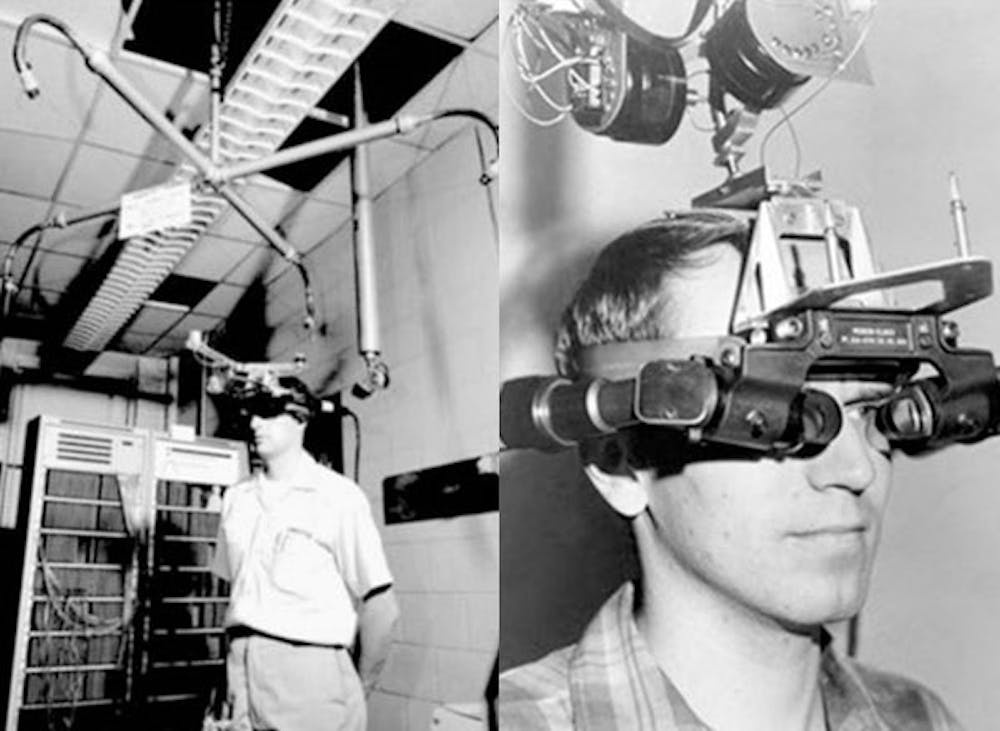
American computer scientists Ivan Sutherland’s Sword of Damocles was the first example of a head-mounted display (HMD).

Fast forward to the mid-80s and the Lincoln Lab produced American AR manufacturer Kopin. In 1990 this commercial company received a US$50 million contract from the Department of Defence to develop micro LCDs to be used in wearable computers for the infantry.

AR continues to see uptake today, in a trend which geographer Stephen Graham refers to as the “militarisation” of everyday life. And this is especially noticeable with technologies governing urban societies.

Technology firm Vuzix is one major player in the security and enterprise sector. As its annual report states, the company develops products for “governmental entity customers that primarily provide security and defence services, including police, fire fighters, EMTs, other first responders, and homeland and border security”.

In one particularly troubling development, last year it was reported that ClearView AI’s facial recognition software was being tested to run on Vuzix hardware.

This controversial company trains its artificial intelligence software on a dataset of more than three billion images from websites including YouTube, Facebook and Instagram. Its marriage with Vuzix points to a future where law enforcement officers use wearable AR with built-in facial recognition capbilites.

The use of AR to govern everyday life has also emerged during the COVID-19 pandemic (which we’ve detailed in this report). For example, companies such as Rokid and KC Wearables have developed wearable devices that purport to track the body temperatures of people in the view of the device’s wearer.

What’s so bad about Microsoft’s AR?

We know little about the current prototyping and field testing of Microsoft’s IVAS. But the interface raises the same concerns that surround other technologies designed to preemptively target and classify potential “threats” – such as drones.
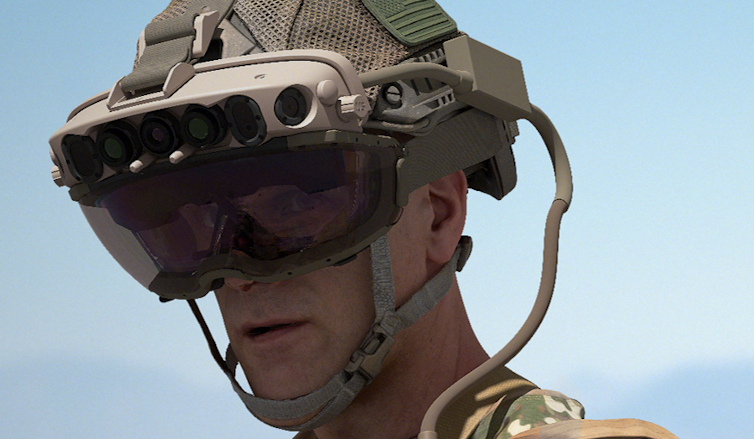
This is what the current IVAS prototype looks like. Microsoft

As the US Army’s IVAS objectives read, key outcomes are to increase mobility, situational awareness and lethality – that is, deadliness on the battlefield. The document states:

Soldier lethality will be vastly improved through cognitive training and advanced sensors, enabling squads to be the first to detect, decide and engage. Accelerated development of these capabilities is necessary to recover and maintain overmatch.

The objectives are framed around soldiers’ efficiency, coordination and safety. This is similar to the usual framing of other predictive sensing technologies, including facial recognition.

The reality, however, is there would be potentially disastrous outcomes if such a system were to misidentify a target. In a 2019 CNN interview, Microsoft CEO Satya Nadella tried to play down concerns.

“We made a principled decision that we’re not going to withhold technology from institutions that we have elected in democracies to protect the freedoms we enjoy,” he said. His statement failed to acknowledge the potential risk which may result from the military’s use of AR.


Read more: What you see is not always what you get: how virtual reality can manipulate our minds


Not child’s play

Following Microsoft’s initial IVAS contract in 2018, Microsoft employees wrote a letter to company executives opposing the use of AR for warfare.

While the letter itself was ineffectual, the recent rise of collective worker resistance in Silicon Valley shows promise. More strikes and walkouts in response to unethical developments could help push back against big tech’s self-serving visions of the future.

Similar to virtual reality, AR has so far enjoyed cover from critique by being taken as a benign gaming or entertainment technology.

The latest IVAS contract is an urgent reminder that developments in this technology should be taken seriously. And its potential for harm must not be downplayed.


Read more: Facebook’s virtual reality push is about data, not gaming


Ben Egliston, Postdoctoral research fellow, Digital Media Research Centre, Queensland University of Technology and Marcus Carter, Senior Lecturer in Digital Cultures, SOAR Fellow., University of Sydney

This article is republished from The Conversation under a Creative Commons license. Read the original article.

A Culture Of Corruption Is Engulfing The Australian Government, As Editor, A Sense of Place Magazine, 16 April, 2021.

 A Culture Of Corruption Is Engulfing The Australian Government

By Jenny Hocking: Pearls and Irritations

A culture of corruption is engulfing the Morrison government. It’s not just the endless graft and largesse – the million-dollar contracts to Liberal linked companies, the generously (mis)allocated ‘grants’ to coalition seats, the personal sinecures to retiring party faithful, the cruel illegality of Robodebt – we’ve become inured to all that, this is a corruption of the idea of democratic government itself. It is insidious, pervasive, and in its undermining of political institutions, dangerous.

It can be seen in the government’s disdain for accountability, its retreat from transparency and truthfulness even to the parliament, and its renunciation of basic ethical standards, a collective abrogation of Westminster democratic government. Parliament reserves its greatest censure for those who mislead it, for failing to speak the truth within it, and with good reason. This is the cornerstone of political accountability, the nexus between the electors and the elected, and the critical means through which we hold governments to account. It’s why question time is such a critical part of the parliamentary process and why misleading parliament really matters. Or ought to matter. Without it, there can be no electoral oversight, we cannot know what a government is doing if it lies to the parliament, and to us, about it. Speaking the truth is not just an ethical expectation, it is a democratic imperative.

Scott Morrison’s ‘mistruths’, as Dennis Atkins  noted, ‘transcend the usual’ in his disarming capacity to deny even his own words. With Anthony Albanese’s release of Labor’s widely praised electric vehicle targets Morrison quickly jumped on board, claiming to support EV targets and denying that he had previously ridiculed the technology. Even when confronted with his comments during the 2019 election campaign that electric vehicles would ‘end the weekend’, and that ‘it’s not going to tow your trailer, it’s not going to tow your boat’, he simply denied it. ‘I didn’t ridicule that technology, that’s good technology’.

Sleaze And Self-interest Everywhere: Australia 2021

Morrison’s coldly transactional, ‘spoils for the victor’ approach to government was cemented after his ‘miracle’ victory, as government became a means of rewarding supporters and donors with little thought to policy needs beyond that self-interested coterie. Urgent policy matters demanding national leadership and action – climate change, bush fires, pandemics – are inconveniences to be dealt with politically, if at all.

Nowhere is the dire implication of that lazy, incompetent, politics clearer than in the disastrous mishandling of the vaccine roll-out, the one policy matter the prime minister had insisted on taking full federal responsibility for. The folly of the government’s over-reliance on the AstraZenecca vaccine has now escalated into a public health disaster. Falsely claiming delays, EU blocks and supply issues, the problem of insufficient vaccines has been compounded as AstraZenecca is no longer advised for people under 50, leaving millions of Australians with no immediate prospect of vaccination.

The Prime Minister had set his course to a comfortable early election, envisaging a wave of successful vaccinations and economic renewal and with Covid19 finally in retreat. Is it really only six weeks since the Murdoch minions were dusting off their predictable ‘Labor’s leadership woes’ and ‘Albo’s got to go’ mantras, smoothing the waters for ScoMo’s triumphant electoral return?

None of them reckoned on the explosive effects of former coalition staffer Brittany Higgins’s brave decision to speak out about her alleged rape two years ago by a coalition staffer in the office of Senator Linda Reynolds. Ms Higgins’ courage in speaking out prompted other women to come forward, and they did.

This Must Surely Be The Most Corrupt Government in Australian History

The former Attorney-General, Christian Porter, now faces the most serious allegation of the rape of a child 33 years ago and has launched defamation proceedings against the ABC; Senator Reynolds has been condemned for apparently failing to alert the Prime Minister to  Brittany Higgins’ alleged assault and for later calling Ms Higgins a ‘lying cow’; NSW Nationals member Michael Johnsen has admitted to sexting a sex-worker during a parliamentary debate and inviting her to parliament house, and also faces an allegation of rape; a Liberal staffer photographed himself engaging in ‘a solo sex act’ on the desk of a female MP; coalition members including former ministers have been accused of engaging sex workers inside parliament house and of using the prayer room for sexual encounters. The extent of the sexual dereliction revealed in coalition ranks is simply horrific.

Caught in this slipstream Morrison did what he always does when cornered, he announced another inquiry. In fact, he announced five. The Gaetjens inquiry into what Morrison’s staff knew about Brittany Higgins’ allegation shows the sophistry behind this favoured response to political crises. Morrison told parliament on 18 March 2021 that the inquiry, led by the secretary of his own department of Prime Minister and Cabinet, Phil Gaetjens, was in progress and that he was yet to be updated on its completion date. The following week Gaetjens told Senate estimates that the inquiry had been ‘paused’ on 9 March, and that Morrison had been advised of this on the same day.

In this single exchange, the prime minister had not only blatantly misled parliament, he had also exposed his use of inquiries as their very opposite, as a cynical exercise in political containment. By citing an ongoing inquiry, Morrison routinely refuses to answer questions from journalists, constituents, even in the parliament, while the inquiry itself is quietly ‘paused’ perhaps never to begin at all. Much as the putative NSW police inquiry into the allegations against Porter was closed before it even began.

The government is now beset by twin disasters, first is the daily retinue of sexual miscreants within the coalition, each so deplorable that it quickly obscures what has gone before, and second is the Prime Minister’s attempts to deal with the first. It’s difficult to know which of those is worse – the intractable problems of male privilege, debasement and dominance in the Liberal party, or Morrison’s efforts to cauterise them. Every one of these allegations against government members has been exacerbated by Morrison’s failures of leadership, and in particular his refusal to act against them.

The Dirty Country: Crikey’s Blockbuster Series on Corruption in Australia

Morrison did not remove the underwear-photographing bully, stalker and harasser of female political opponents, Andrew Laming, from the government party room  reprising his standard refrain of Prime Ministerial political impotence and claiming to have ‘no control’ over decisions of the Queensland LNP. Laming was sanctioned instead with a few hours of ‘empathy training’, while on fully paid medical leave. He also remains chair of the House of Representatives standing committee on employment, education and training, which gives him an 11% increase in salary on top of his backbencher’s salary of more than $200,000, despite his acknowledged indiscretions.

Morrison also refused to stand down Christian Porter or to hold an inquiry into the claims against him and declared Porter to be ‘an innocent man’, despite not having read the substantial dossier containing the untested allegations against him. Porter remains in the cabinet with a new portfolio, as does Linda Reynolds.

Finally, in an abject failure of leadership, Morrison declined to speak to the thousands of women in the March4justice gathered outside parliament house demanding action on the (mis)treatment of women in parliament and beyond. One hundred thousand people, mostly women, marched in cities across Australia that day, and the Prime Minister refused to step outside and speak to them. If they wanted to speak to him, then a select group had to come to him. He would speak to them on his terms, or not at all. The silencing of women writ small. Morrison understood neither the issue nor the significance of that moment, and a remarkable opportunity for change was lost.

How Morrison Taught Australian Voters to Relax and Love the Rort

Morrison blithely presented this tableau of inaction as action, announcing a cabinet reshuffle that promised ‘a swathe of changes’. In this tawdry ‘pea and thimble’ trick, the sum total of changes to cabinet was a single new addition to it, Melissa Price. The cynicism was so brazen, it was comical. Did he really imagine that the announcement of lots of women heading lots of ministries for lots of things to do with women, and with Marise Payne as the ‘Prime Minister for women’, could do anything other than reinforce the fact that women ordinarily have no part to play in this gender dysfunctional government? 

The effects of this groundswell of agitation for change are already being felt, with the most recent opinion polls showing a sharp turn, particularly in the female vote, against the government.

Labor now consistently leads the coalition in 2 party preferred vote at 52:48 in both NewsPolland Essentialpolls. And as the electorate turned and with trust in the coalition eroding, NewsCorp swung into action in a concerted effort to convince us that first, there was no problem just a lot of noisy women with no clear agenda, and second that Morrison was dealing with it, whatever it was. 

In a dazzling display of condescension even by their standards, an array of The Australian’s finest then presumed to tell women what they are doing wrong and what they should be asking for in order to really achieve ‘change’ – as defined by them and as acceptable to them: ‘Plenty of angerbut surprisingly few ideas’, ‘outrages rather than solutions’, ‘tantrums’, ‘sanctimonious grandstanding’, ‘hysteria’ – you get the drift.

Australian Prime Minister Scott Morrison’s Method – If You Don’t Ask, You Can’t Tell

Despite the hyperbole, every member of the previous cabinet remains in the newly refurbished cabinet including the most tarnished ministers Christian Porter and Linda Reynolds, and Andrew Laming remains on the government benches.

These ‘Honourable Members’ are a daily reminder of Morrison’s disregard for the treatment of women and each of them a beacon for further revelations that will haunt the government until election day.  Laming is now the subject of an Electoral Commission inquiry into his undisclosed and unauthorised use of more than 30 facebook pages for political purposes.

This is just the start of what will be a running sore for the government, an electoral liability of its own making.  Impervious to the demands for accountability, Scott Morrison has left the toxic heart of the government in place, and he will pay the political price for that appalling misjudgment.


Jenny Hocking is emeritus professor at Monash University, Distinguished Whitlam Fellow at the Whitlam Institute at Western Sydney University and award-winning biographer of Gough Whitlam. Her latest book is The Palace Letters: The Queen, the governor-general, and the plot to dismiss Gough Whitlam. You can follow Jenny on Twitter @palaceletters.

Monday, 12 April 2021

Yuri Gagarin’s Boomerang: The First Person To Return From Space And His Encounter with Australia, As Editor, 13 April, 2021.

 Yuri Gagarin’s Boomerang: The First Person To Return From Space And His Encounter with Australia

By Alice Gorman, Flinders University

Sixty years ago, Russian cosmonaut Yuri Gagarin became the first human to travel in space when he completed his historic orbit of Earth on April 12, 1961.

It was an extraordinary achievement, but created a dilemma for a world embroiled in the Cold War. Gagarin’s spaceflight heralded a vision of a unified planet.

However, in the battle between communism and capitalism, space technology was also a weapon to demonstrate the superiority of one political system over the other.

The Soviet Union was winning the battle. In 1957, it orbited the first satellite with Sputnik 1. Two years later, the Luna 2 probe was the first human artefact to make contact with the Moon. In February 1961 the Russians launched the Venera 1 probe towards Venus.

As congratulations for Gagarin’s feat poured in from around the world, the vehemently anti-communist Australian prime minister Robert Menzies stayed silent.

His views were echoed by members of the Australian scientific establishment. Sir John Eccles, president of the Australian Academy of Science, said the flight was of little value to humanity. Nuclear scientist Sir Mark Oliphant described it as a stunt.

Physicist Harry Messel said:

Scientifically I am happy, but from the cold-war perspective I am sad … it could very well threaten the freedom of the world if Russia continues to triumph in space.

Sputniks and vodka at the Sydney Trade Fair

The Australian public had other ideas. In August 1961, Sydney hosted an international trade fair with a large Russian pavilion.

Such was the buzz that Henry F. Jensen, the Labor Lord Mayor of Sydney, invited Gagarin to visit as part of his post-flight world tour. A request was sent through the Soviet embassy in Canberra, which passed it on to Moscow. Jensen said:

I am certain Sydney citizens will give him a very warm welcome if he comes here.

Throughout July and August, newspapers reported on whether the invitation had been answered. Anticipation was building.

The Russian pavilion had two life sized replicas of Soviet spacecraft and the public flocked to see them. It was the most popular pavilion at the trade fair (although the mini-bottles of vodka that were given away may have helped too).

Not everyone was happy about it. On August 12, an anonymous caller told police there was a bomb in the Russian pavilion. After evacuation, the bomb threat was proven to be a hoax.

It’s not known if the Lord Mayor’s invitation ever reached Gagarin. Over the next year the cosmonaut visited more than 25 countries on his world tour, but Australia was not among them.

The Space Boomerang

That said, Gagarin still had a close encounter with Australian culture. Australian journalist Wilfred Burchett and his British colleague Anthony Purdy were the first Western journalists invited to interview him privately.

Burchett was the first foreign war correspondent to enter Hiroshima in 1945, and had been hounded out of Australia by the government for his communist sympathies.

Burchett and Purdy met with Gagarin and his interpreters at the State Committee of Foreign Cultural Relations in Moscow, on July 9 1961. They wrote a book about it, contextualising the interview within the broader Soviet space program.

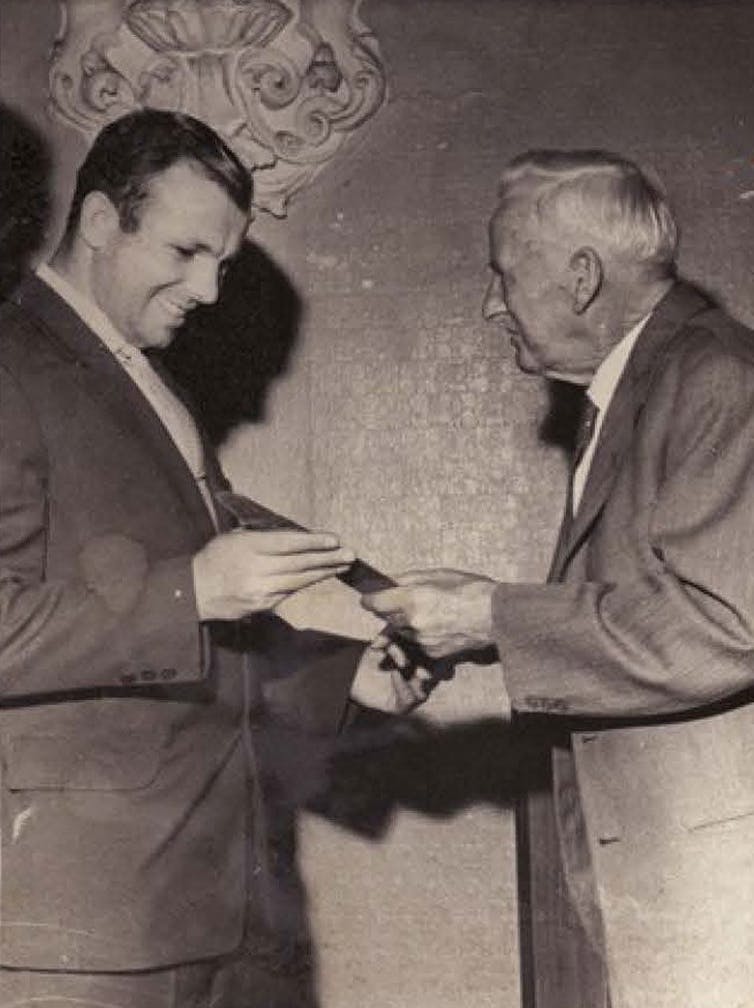
Burchett’s father George was on holidays in Moscow at the time. Just as Gagarin was leaving, George walked in with a boomerang he had in his luggage. He offered it to the cosmonaut, saying “please take this as a symbol of safe return”.

“It always comes back, and I hope you and your colleagues do too.”

George Burchett presents a boomerang to Yuri Gagarin, July 9, 1961. National Library of Australia, File 13, Box 3

Gagarin was delighted, examining the boomerang closely while the interpreters explained its use. They returned his thanks to George Burchett: “I shall treasure it. It’s a nice sort of symbol to have”.

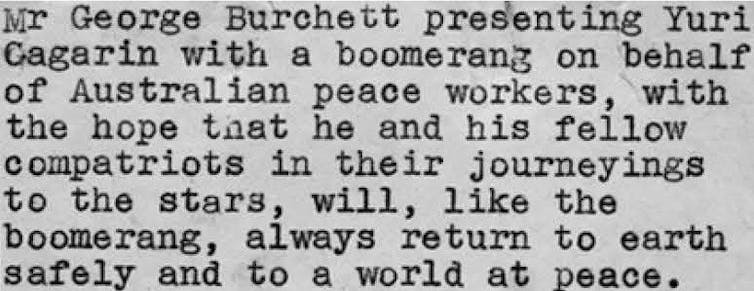
The label on the back of the photograph, now in the National Library of Australia, says:

Label on the back of photograph. National Library of Australia, File 13, Box 3

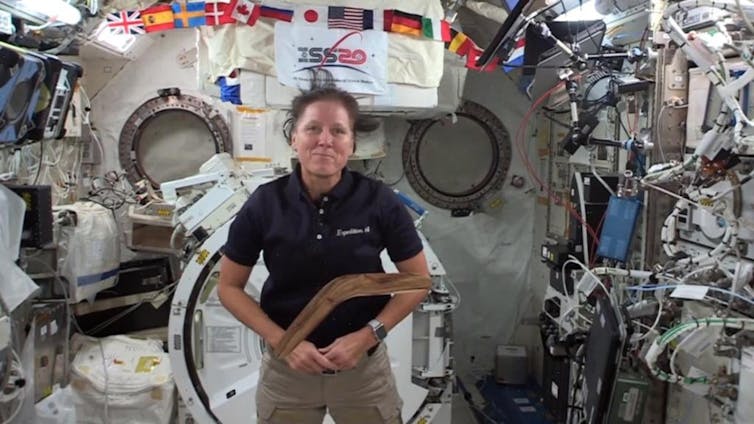
In January this year, nearly 60 years after Gagarin’s epic flight, a boomerang carved by Kaurna and Narungga man Jack Buckskin was taken onto the International Space Station by astronaut Shannon Walker.

US astronaut Dr Shannon Walker with the boomerang on the ISS. NASA

Space politics in the global south

On one hand, Gagarin’s spaceflight was a symbol of unity and peace. On the other, it fostered the fear of Soviet aggression from space that started with Sputnik 1. The US also had to obscure its military objectives in space to create a public perception of peaceful intent.

The world tour was an important exercise in soft diplomacy, particularly when Gagarin visited countries such as Ghana and Brazil, which were not aligned with either the US or USSR.

Soviet technology’s promise of modernisation, as seen at the Sydney Trade Fair, was a powerful lure for nations in Africa, Latin America and Asia.

But many rejected the premise of the Cold War. In May 1961, a newspaper in Uruguay asked readers to imagine

the benefits to be gained if the American and Soviet scientists were to unite their efforts […] if these feats were intended to unite rather than divide.

Yuri Gagarin holds a dove presented to him by the Bulgarian Young Pioneers, in Sofia, May 1961.

The paradox is captured in one of the most famous photographs of Yuri Gagarin, where he holds a dove, an international symbol of peace, while wearing his military uniform and decorations.

This image is frequently displayed in the Russian segment of the International Space Station.

Gagarin never flew in space again. He was tragically killed in a jet crash in 1968. Around the world civil, revolutionary and international wars were being waged, the most well-known being the American War (also called the Vietnam War) which continued until 1975.

Perhaps no space traveller has ever returned to a world at peace.

Alice Gorman, Associate Professor in Archaeology and Space Studies, Flinders University

This article is republished from The Conversation under a Creative Commons license. Read the original article.

ALSO BY ALICE GORMAN IN A SENSE OF PLACE MAGAZINE