Saturday, 3 June 2000

Battered by the System, The Australian, 3-4 June 2000.


Battered by the system

The Weekend Australian - Focus 3-4 June 2000

Nobody believed 'Frank' when he tried to protect his son from
bureaucratic bungling. John Stapleton reports that, nearly 20 years
on, Frank has been proved right, even though he lost in court.

[Picture: Father and son: "Frank" and "James"]

The boy was eight weeks old when his father called welfare authorities
and pleaded with them to take his son into foster case. He alleged
that the mother was being violent towards the child, throwing him
against walls and trying to smother him. The authorities ignored him,
as they did for years to come, but the father persevered.

Twenty years, 550 days in court and tens of millions of dollars of
public funds later, the matter which has just run across the civil,
criminal and family law jurisdictions, reached its final chapter this
week.

Last year the Office of the Director of Public Prosecutions, satisfied
there was a prima-facie case, laid charges against the mother for
tying her son in a cot with a rope, striking him in the face, throwing
him against a wall and "causing him actual bodily harm", events
alleged to have occurred in 1981-82.

But earlier this week, in a judgment highly critical of earlier police
inaction, Sydney's Downing Centre Local Court issued a permanent stay
on proceedings, primarily due to the time that has elapsed since the
alleged offences occurred.

Magistrate Hugh Dillon said the disappearance of police records raised
the suspicion of a cover-up. But he said the "appalling" treatment the
Police Service meted out to the father did not detract from the issue
of the mother facing a possible abuse of process because of the
20-year delay.

One of the sad ironies of the case is that, although the father does
not see it this way, in many of his claims of judicial, police and
political inaction as well as inappropriate behaviour by the NSW
Department of Community Services have been vindicated in a series of
court judgments. But nobody has been found guilty, no compensation has
been paid.

End of the road
The following are excerpts from this week's
judgment in the Local Court of NSW by
magistrate Hugh Dillon, who granted a
permanent stay on the case against the m
other of "James", which alleged she
bashed and tied up her son in 1981-82. The
real names of those involved in the case have
been suppressed by the court.

"There is no explanation before the court as
to why or how the investigation stopped once
the father had set it in train. No one has ever
explained to the father what happened during
the investigation or what decisions, if any,
were made by those originally in charge of it.
the fact that police records, which would,
presumably, explain these things, have
disappeared  raises a suspicion that police
officers have been involved in covering up
their own negligence or the negligence of
colleagues. Beyond this,  we can merely
speculate.
"I feel considerable sympathy for the father
... it is appalling that it has taken him almost
20 years to get the Police Service to take
action on evidence [that] it has had for most
of that time.
"A reasonable and right-minded person
might have his or her confidence in the justice
system undermined because the
father has been treated so badly.
"Yet is it now just ... to continue the
proceedings because the father was unjustly
or unreasonably treated ... for many years?
This is ... one of those rare or exceptional
cases where the delay in proceedings has
been so excessive that the proceedings constitute
an abuse of process.
"These proceedings are permanently stayed."


The long history of the case means it offers a time-tunnel view of the
behaviour of bureaucracies in the face of an outraged and persistent
litigant. Its resolution comes as sex and family issues are attracting
worldwide media attention, with focus on the high suicide rates of
separated men and the behaviour of family courts, child protection
authorities and court-appointed psychiatrists.

An expert on female abuse of children, Dr. Malcolm George of St
Bartholomew's Hospital in London, says it if "par for the course",
where the mother is the alleged abuser, for institutions to spend
large amounts of money defending their decisions,, based on an
ideology that "denies that women can be violent and abusive".

It was nine years ago that The Weekend Australian broke the story of
"James" and his father "Frank" on its front page, illustrating one of
the most under-reported and under discussed crimes in Australia today:
physical and sexual abuse of children by women.

[Illustration: A copy of the Weekend Australian April 6 1991 story
"Why it took years for Frank to save his son".]

Although Australian and international research clearly indicates that
children are most at risk from their mother, followed by their step
father and live-in boyfriends, almost a decade on crimes of this type
remain significantly under-reported and under-researched.

'I get flashbacks: a
smell, an idea can
trigger them'
'James'

During his early years, Frank - the family's real names have been
suppressed by the courts - made hundred of calls and applications to
police, welfare organisations, the NSW Department of Community
Services, parliamentarians and the Family Court. But it was not until
1984, when the child was four years old, that at least some members of
the department appear to have begun taking the accusations seriously.

A report by an independent clinical psychologist gave a graphic
account of James attempting to have oral sex with her - behaviour
considered to have been acquired from a woman. A departmental
psychologist and a child protection worker then interviewed the mother
and the child. They concluded that James was an "emotionally deprived
little boy who has been sexually abused and has been exposed to adult
sexual behaviour".

For almost two years from this date, the father was prevented from
seeing his son through Family Court orders, actions by departmental
officers and recommendations by Sydney psychiatrist Dr Brent Waters,
who had been a favourite of DOCS, the Family Court and Legal Aid over
many years.

Waters recommended custody be with the mother and that the father be
denied access. The Citizens Commission on Human Rights, which
campaigned for the Chelmsford deep sleep inquiry in the 1980s, has
helped prepare a number of complaints against Waters in the past year.
Waters has declined to comment.

The journal Psychiatry, Psychology and the Law's editor-in-chief Dr
Ian Freckleton says there is a long  and disappointing history of
bureaucracies responsible for the welfare of child not acknowledging
errors.

"A particular difficulty exists in relation to the independence of
advise," he says. "Welfare department often utilise services offered
by mental health professionals who interlink with the departments in a
complex of advisory, consultant and expert roles, all of which can be
well paid and career-enhancing."

Repeated attempts by Frank in the early 80s to gain custody failed. In
1986, James was bashed with a cricket bat. Frank Alleges the boy's
mother's then de facto husband was responsible. The man was never
questioned. A Children's Hospital report from the time reports
evidence of a recent severe beating "suggesting he had been held on
the face and struck". The report noted "extensive bruising ...
blue-black in colour" and records the six-year-old's long association
with the hospital for similar problems.

In desperation, the father finally gained full custody of his son by
locating the home of the then federal attorney-general Lionel Bowen.
Braving dogs, he knocked on the door. Bowen was not at home but his
wife answered the door and listened to Frank's story. James has not
seen his mother since.

The Ten network;s footage of the child when he was 11 shows a quiet,
well-mannered boy asking: "Why was it me, why was it me that got
hurt?" He said his mother "should be put in jail for life, I just hate
her".

James, now 20, is on medication and rarely leaves the house. He has
consistently maintained for several years that he remembers
psychiatrist Waters saying: "Don't tell anyone about the naughty
things mummy's doing."

"I was so young," James recalls. "The main things that come across now
- I get flashbacks: a smell, and idea can trigger them. It is more a
sense of fear. I used to dream a lot, nightmares ... about my mother.
I was extremely scared of her. I remember certain episode and events
... when her husband beat me with a cricket bat ... I felt anger, but
more than anything, no I feel pity."

The obsessive campaign for justice by Frank has touched many of
Australia's best known people and has been mentioned in parliament 14
times. Among the judges who ruled against the father was Elizabeth
Evatt, a former chief justice of the Family Court and now a member of
the UN Human Rights Committee. Justice John Ellis, now a senior Family
Court judge, also ruled against Frank.

The dozens of politicians whom the father approached - unsuccessfully
- for help include Paul Keating, Gareth Evans, Neville Wran, NSW
Minister for Women Faye Lo Po' and NSW Police Minister Paul Whelan.

DOCS officers in the early 1980s accused the father of being violent
and threatening a number of solicitors. None of these accusations was
proved.

After press coverage his local member, the then shadow minister for
industrial relations John Howard, called for an independent inquiry.
In 1992 he told parliament: "I have satisfied myself, from very
lengthy interviews with my constituent and from an exhaustive
examination of a huge file, that the complaints that he has brought to
me about the conduct of officers of the then Youth and Community
Services Commission in NSW are justified". Independent Ted Mack also
claimed welfare officers showed "prejudice and bias ... against the
father when he made efforts to protect his child".
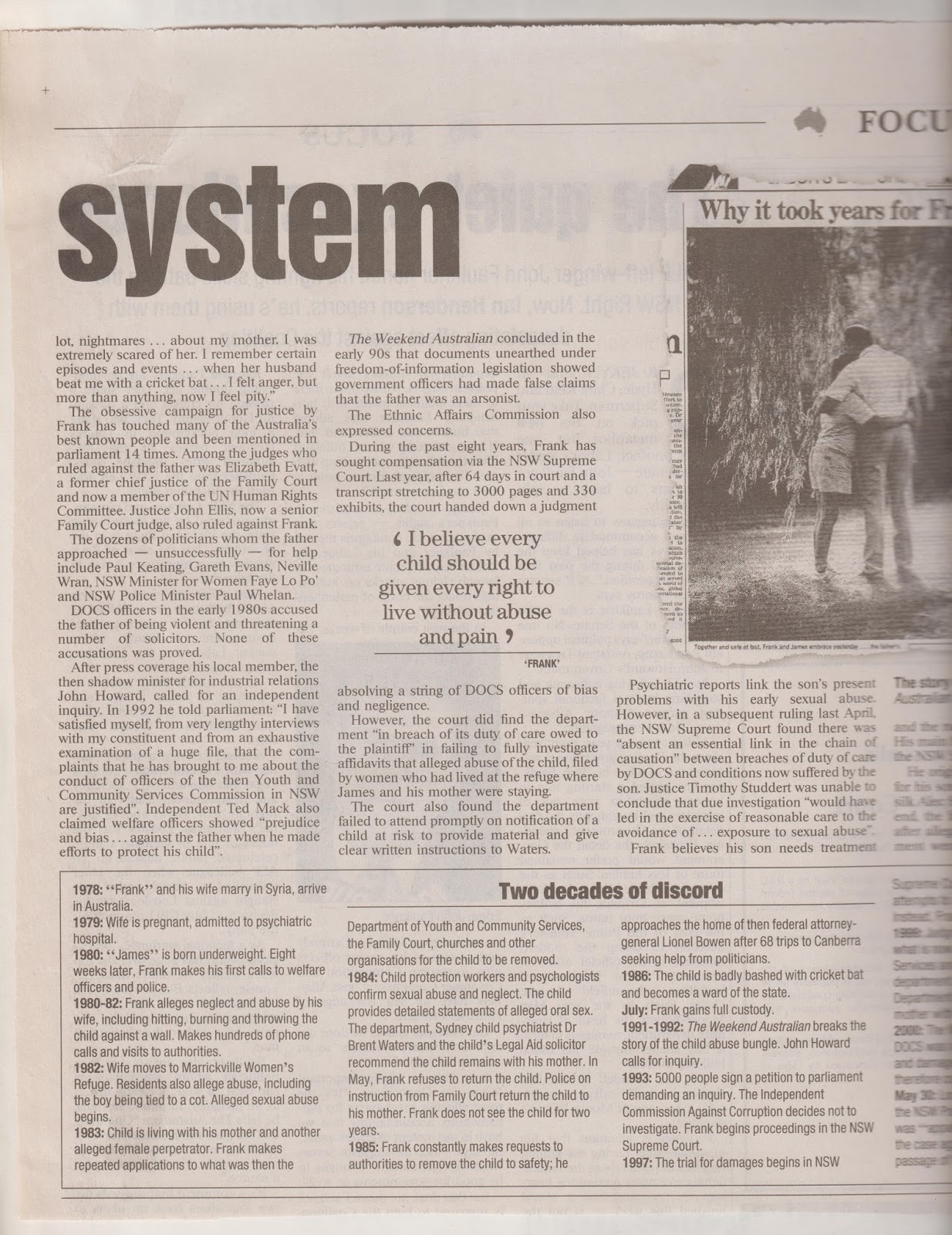
Two decades of discord
1978: "Frank" and his wife marry in Syria, arrive in Australia.
1979: Wife is pregnant, admitted to psychiatric hospital.
1980: "Janes" is born underweight. Eight weeks later, Frank makes his
first calls to welfare officers and police.
1980-82: Frank alleges neglect and abuse by his wife, including
hitting, burning and throwing the child against a wall. Makes hundreds
of phone calls and visits to authorities.
1982: Wife moves to Marrickville Women's Refuge. Residents also allege
abuse, including the boy being tied to a cot. Alleged sexual abuse
begins.
1983: Child is living with his mother and another alleged female
perpetrator. Frank makes repeated application to what was then the
Department of Youth and Community Services, the Family court, churches
and other organisations for the child to be removed.
1984: Child protection workers and psychologists confirm sexual abuse
and neglect. The child provides detailed statement of alleged oral
sex. The department, Sydney child psychiatrist Dr Brent Waters and the
child's Legal Aid solicitor recommend the child remains with his
mother. In May, Frank refuses to return the child. Police on
instruction from Family Court return the child to his mother. Frank
does not see the child for two years.
1985: Frank constantly makes requests to authorities to remove the
child to safety; he approaches the home of the then federal
attorney-general Lionel Bowen after 68 trips to Canberra seeking help
from politicians.
1986: The child is badly bashed with cricket and becomes a ward of the state.
July: Frank gains full custody.
1991-92: The Weekend Australian breaks the story of the child abuse
bungle. John Howard calls for an inquiry.
1993: 5000 people sign a petition to parliament demanding an inquiry.
The Independent Commission Against Corruption decides not to
investigate. Frank begins proceedings in the NSW Supreme Court.
1997: The trial for damages begins in NSW Supreme Court. After three
weeks, Frank attempts to sack Alec Shand QC from the case. Instead,
Frank is removed as "tutor".
1999: Judgment absolves a string of officers from what is now the
Department of Community Services and Waters of wrongdoing, but finds
the department in breach of duty of care. The NSW Department of Public
Prosecutions charges the mother with physical abuse of the child.
2000: The NSW Supreme Court find that, though DOCS was negligent, the
link between negligence and damage to the child cannot be established,
therefore compensation is not paid.
May 30: Local Court magistrate Hugh Dillon finds the NSW Police
Service Performance in the case was "appalling", but grants permanent
stay of the case against the mother because of passage of time.

The weekend Australian concluded in the early 90s that documents
unearthed under freedom-of-information legislation showed government
officers had made false claims that the father was an arsonist.

The Ethnic Affairs Commission also expressed concerns.

During the past eight years, Frank has sought compensation via the NSW
Supreme Court. Last year, after 64 days in court and a transcript
stretching to 3000 pages and 330 exhibits, the court handed down a
judgment absolving a string of DOCS officers of bias and negligence.

'I believe every
child should be
given every right to
live without abuse
and pain'
'FRANK'

However, the court did find the department I'm "in breach of its duty
of care owed to the plaintiff" in failing to fully investigate
affidavits that alleged abuse of the child, filed by a women who had
lived at the refuge where James and his mother were staying.

The court also found the department failed to attend promptly on
notification of a child at risk to provide material and give clear
written instructions to Waters.

Psychiatric reports link the son's present problems with his early
sexual abuse. However, in a subsequent ruling last April, the NSW
Supreme Court found there was
absent an essential link in the chain of causation" between breaches
of duty of care by DOCS ann conditions now suffered by the son.
Justice Timothy Studdert was unable to conclude that due investigation
"would have led in the exercise of reasonable care to the avoidance of
... exposure to sexual abuse".

Frank believes his son needs treatment and the ruling leaves him
without vital help. His main focus now is his outrage at the way the
NSW Supreme Court dealt with the case.

He originally acted as "tutor" or guardian, for his son, the
plaintiff. Well known Sydney silk Alec Shand QC took on the case. In
the end, the father was removed from the case after allegations that
his emotional involvement went against his son's best interests.

Frank may very well not have helped his case through the years by
calling everyone who would not help him, including judges, politicians
and police, "evil, disgusting, protectors of paedophilia" and so on.
Transcripts from the Supreme Court show much legal huffing and puffing
over the man's "scurrilous" attacks.

Frank alleged in a complaint to the Legal Services Commission that
Shand, once granted legal aid "hijacked" the case. He alleges that
Shand deliberately concealed evidence from the court and failed to
cross examine witnesses. The commission found no wrongdoings on the
part of Shand.

Frank believes that the system, including the judiciary and
politicians generally, has acted to protect the interconnecting webs
of Legal Aid, DOCS and the Family Court. He says that his case is not
just a failure of the system" "I am saying the whole system is
immoral, inhuman.

"The abuse of my son was known to the authorities from when my son was
weeks old to when he was 61/2. Instead of the system protecting my son
from horror abuse, they left my son in a dangerous situation and then
proceeded to protect the people who were abusing him.

"I believe one thing" every child should be given the right to live
without abuse and pain and suffering."

Although Frank has been dismissed by members of the legal profession
as "paranoid" and "unpleasant", his is not that uncommon a view.
Whistleblowers Australia's national president Dr Jean Lennane says
DOCS, Legal Aid and the Family court "have very close connection -
incestuous you might say".

"What tends to happen is that the aggrieved party, the whistleblower
or litigant early on gets labelled as a troublemaker and mentally
unbalanced, unofficially or with the help of a hired-gun psychiatrist
or psychologist," says Lennane.

"Once that has happened, nobody in any part of the bureaucracy is
usually willing to examine the facts of the original complaint. You
find it constantly. The main point is the waste of public money.

The scars of what happened to the family in the early 80s are still
visible. James after struggling to concentrate at school, is at a
turning point, not sure where his life will lead.

His mother has remarried and has two other children.

Frank, a pensioner, is fearful that he will be hit with a cost order
for millions of dollars for his Supreme Court Action. His hope that
his case would help stop other children being abused and provide a
comfortable future for his son is in ashes.

He believes there are other fathers doing, as he did, everything they
can to protect their children and being frustrated in the process.
"There is no doubt it is still happening today," he says.

Statistical risks
Although there has been little Australian research, international
studies indicate that children are most at risk of abuse from their
mothers.

US
The US Government's 1997 report Child Maltreatment found 62.3 per cent
of perpetrators were women.
The Heritage Foundation Study, The Child Abuse Crisis, found that of
the approximately 2000 children killed each year, 55 per cent were
killed by mothers, 25.7 per cent by live-in boyfriends, 12.5 per cent
by stepfathers, and 6.8 per cent by biological fathers.
The 1995 report US National Incidence of Child Abuse and Neglect found
that where maltreatment led to death, 78 per cent of perpetrators were
female. Boys were four times more likely to be fatally abused and 24
per cent more likely to be seriously abused than girls.

UK
The book Broken Homes and Battered Children reports that the child of
a biological mother cohabiting with a man other than the natural
father is 33 times more likely to suffer serious abuse that a child
with married natural parents.

Australia
Although there is a contention over what constitutes a substantiation,
the latest statistics from the Australian Institute of Health and
Welfare, based on an amalgam of data from some states, suggests 31 per
cent of child abuse cases occur in natural families, 20 per cent in
step or blended families, 40 per cent in single-mother households and
5 per cent in single-father households.

Background material for Battered by the System, 3 June, 2000.

For all its faults The Australian remains the only paper in Australia to have ever tackled this subject, the only paper prepared to fly in the face of fashionable shibboleths and to invest the time and energy to investigate this complex story..
The Family and Children's Courts are protected by rafts of legislation making them almost impossible to report.
The legislation purports to protect children.
It does nothing of the kind. It protects lawyers and an utterly dysfunctional judicial system.
The behaviour of these jurisdictions would shock any lay person, if only they were encouraged to understand them.
These are the original stories that preceded Battered by the System.


Battered by the system, Text Only, The Australian, 3 June, 2000.


Tuesday, 30 May 2000

Original copy, Battered by the System, The Australian, 30 May, 2000.

Story published 3 June, 2000.
This is the original copy, which varies to some fair degree.
This was the longest running case in Family Court history, and a particularly complex and revealing case.
Sometimes in the early hours, trying to make sense of it, I would lay out the documents in a line at least 50 feet long.


.


Friday, 19 May 2000

Child Support Agency Case Studies, The Australian, 19 May, 2000.

Not all these case studies were used.
The Australian Child Support Agency is directly linked to the high death rates and poor outcomes of separated parents, and is one of the most dysfunctional, destructive and despised of all government departments. It is a significant contributor to high unemployment rates and is extremely poorly managed. As one CSA whistle blower told us, the tidal wave of hate and distress begins the minute the phone services open, and does not stop all day, every day.
Australian politicians have either ignored the problem or made promises they never kept. Yet they know perfectly well they are driving people to suicide or tuning their life to mud.
Statistics demonstrate the average money received for the child of a separated parent is less than when the Agency was created.


Wednesday, 10 May 2000

Christmas Day. Dads On The Air. 2000.

Christmas Day - John Stapleton

CHRISTMAS DAY. A POLICE STATION CAR PARK. Malcolm has not seen his nine year old son and six year old daughter for more than a month.
The children don't get out of the car. Their father pushes presents at them through the car window, tries to talk to them. After five minutes, the children are driven off. Malcolm has only seen his son in sessions with a Family Court appointed psychologist since. Malcolm is one of an estimated 326 Australians, primarily fathers, accused of sexually abusing their children each week - the atomic bomb of custody disputes. Like thousands of other fathers; his life has imploded into an expensive nightmare of litigation and conflicting experts.
A senior public servant with special security clearance, he can be trusted with the country's secrets, but not with his own children. While a female child protection worker found no evidence of abuse and condemned the mother's behaviour; it is the crucial family report by the court appointed psychologist, who recommended the father have minimum contact, that Malcolm will have most difficulty overcoming. Despite their notoriety amongst father's groups for their bias, innacuracy and unchanging nature over a quarter of a century the Federal government has refused to acknowledge any community concern over their veracity.
These reports, the evidentiary bedrock of Australian family law, are written by court counsellors or court appointed psychiatrists and psychologists, who normally interview each of the parties for an hour each. Research shows judges rely almost totally on them to make their judgements. Many of these "experts" spend longer in the witness box than they ever do interviewing the families involved, yet there is no scientific evidence to suggest that interviewing people is the best way to determine a custody issue.
The widespread hopes held by many community groups that the Liberal government would move promptly to reform family law, and the family reports on which it is based, have been dashed. The divorce industry is now worth an estimated $5 billion a year, an industry as big as beef, sheep or horse racing. That the present Attorney General has no intention of seriously tackling this cash cow for his fellow lawyers is evidenced by his choosing personnel from deep within the industry for his new Federal Magistracy and for the so-called Family Pathways Advisory Group. The dirty little secret, the secret that these lawyers have no intention of blowing the whistle on, is that this industry rests on spurious, often blatantly dishonest reports from Family Court Counsellors, psychiatrists and psychologists. This is perjury on a grand scale - and the legal profession is entirely complicit in it.
The newly created $26 million Federal Magistrates Service, up and running around the country since July, has shown no signs of differentiating itself from the Family Court. It has turned for magistrates to people who have a long professional association with the much reviled family reports and who's biases are for the main part well known. The government has refused to deny that the magistrates have all received the approval of the Family Court. One newly appointed magistrate, Judith Ryan, former head of the Family Law unit of Legal Aid, was responsible for the repeated use of Sydney's "big three" Drs Peter Champion, Brent Waters and Rikard-Bell, all favourites of DOCS as well as the Family Court. Ms Ryan took it upon herself to seek the silencing of National President of Dads Peter Vlug after he appeared on a radio show Life Matters on Radio National.
She requested one of her employees listen to a tape of Radio National in which National President of Dads Against Discrimination Peter Vlug highlighted the issue of false sexual abuse allegations in the Family Court. That Legal Aid employee was then requested to write an affidavit claiming she recognised the voice of Mr Vlug. He regards the actions taken against him by Legal Aid as blatant abuse of public funds.
"I was asked to go on the program," he said. "False allegations occupy a considerable amount of the court's time and therefore taxpayers money. It was a matter of public interest." The Liberal government's move to consult "key stakeholders", the Family Pathways Advisory Group, submissions for which close this month, has become the Royal Commission that never was. The Group does not have a single father's group on it despite ample representation from heftily funded feminist advocacy groups, academics and institutional heavyweights. The "Group", set up in the wake of an Australian Law Reform Commission report which found overwhelming disquiet with the Family Court and its processes, comes at a time when there are mounting questions over the level of public confidence in the court. One of its founders, Gogh Whitlam, has declined the opportunity to defend the contemporary court. Yet virtually no one on the group is even remotely critical of the Family Court; one of its members, Cathy Argall, has been publicly denying the Child Support Agency's role in the 20 suicides a week committed by men after separation and another academic, John Dewar, who's faculty has just received $500,000 in funding, has suggested the broad push to shared parenting is detrimental to women's interests. Despite their importance and the millions of dollars of funding flowing to groups such as the Australian Institute of Family Studies and the Family Law Council, there has never been an audit or academic study of family reports. Both the government and the AIFS have refused to offer an explanation.
National President of Whistle Blowers Australia Dr Jean Lennane says the same misuse of psychiatry occurs in the Family Court as other courts, but its secrecys mean it is less well documented and it leads to "some very bad miscarriages of justice towards children who are deprived of access to one or other parent on the basis of ... very dubious psychiatric evidence. They are relying on spurious reports and misinformation. The secrecy has allowed enormous abuses ofp rocess to develop."
President of Lone Father's Barry Williams says the failure to include fathers on the Family Pathways group is blatant discrimination. "If this government was listening to the people who are hurting they would abolish the Family Court," he said. "It hasn't changed in a quarter of a century, it seems to be a protected species. It has to be replaced by a Tribunal.
"The court is bringing the entire legal profession into disrepute. We get 22,000 calls a year. People are committing suicide as a result of court decisions."
Mr Williams said father's can lose any relationship with their children based on "very biased" reports by court counsellors made up of "inuendo or make believe" which they may not even be permitted to see.
"When a man wants to see his children they say he is trying to control the woman. It is not true at all. They want to see their kids because they are part of their life."
"The reports are ill written, foolish and irresponsible." Malcolm's case comes at a time when there is scathing media attention on family courts throughout the English speaking world. Prominent feminists in the US have come out recently supporting father's groups position that shared parenting liberates everyone involved, adding a twist to the ideologically driven vortex. The quarter of a century since the establishment of the Family Court of Australia has been characterised by a potent mix of feminism, psychology, psychiatry and the law, but it may well be money and the law which ultimately unravel the system. The European Human Rights Court recently awarded a father $40,000 in compensation for breach of his human rights after the father was denied access to his child in the German courts. Equally in Australia there are signs of an impending wave of litigation. Fathers for Family Equity have commenced a project to initiate a wide-ranging class action against the government and the Family Court over bias, discrimination, injustice, abuse of power and damage to children. With more than 20 men a week killing themselves post-separation, simple arithmetic shows such an action could cost taxpayers tens of billions of dollars.
In a landmark case, Blue Mountains solicitor Hal Ginges was recently awarded an undisclosed sum and a public apology from the Department of Community Services over false allegations of sexual abuse of his children involving DOCS officers. Illustrating their close connections, the investigation by DOCS led to orders in the Family Court that the father's contact with his children be restricted and supervised. "Ultimately the children found their own way back," Mr Ginges said, who practices in the Children's Court and the Family Court. "Things haven't changed. Fathers are still being falsely accused and undertrained officers of DOCS are still taking children away and relying on untested allegations." Former President of the NSW Family Law Reform Association Max King has recently began a $1.4 million dollar compensation test case which in the NSW Supreme Court, naming Chief Justice of the Family Court Alistair Nicholson as a defendant in his role as administrator of the Court. He hopes the case will expose the practices of the Family Court and the nature of the family reports to public scrutiny. Any discussion of the role of psychiatric evidence in the Family Court leads straight to the question of false sexual abuse allegations. For Malcolm, he is caught up in a maze of conflicting affidavits and legalistic complexities. An affidavit from a baby sitter, who notified the police, reports the mother dropping off the children, claiming they had been sexually abused, and then promptly going out on a date.
Malcolm has never been charged or found guilty of anything, but like many many thousands of other fathers, if the matter ever goes to trial the war of contradictory experts, many of whom may spend more time in the witness box than they ever did interviewing the family, may well be enough, despite the lack of medical evidence, for a judge to entertain "lingering doubts" sufficient to deny him any contact at all with his children until they turn 18. Very few of those accused of sexual abuse of children are ever convicted; but the allegations prompt a cascade of events from The Child Abuse Industry, to quote the title of a 1980s American book warning that the self referencing and ideologically driven child protection bureaucracy was out of control. As forensic psychologist Yolande Lucinde wrote in a recent paper presented to the Australian Academy of Forensic Sciences, the child abuse epidemic "has all the characteristics of mass hysteria, now called moral panic...driven by hysterical beliefs, unvalidated and untrue."
Dr Lucire says that in terms of the numbers of people and resources involved we are in the greatest moral panic since the Salem witch-hunts.
She regards the "so-called substantiation" recorded by welfare departments as nothing more than assertions and notes that in reality child sexual abuse is "very very rare", and only found amongst "very disordered people in disordered families." "It is quite improbable," she says. "The allegations arise in the context of custody battles. Some studies indicate 80% of the accusing parents have massive personality disorders... probability analysis indicates that any one report is many times more likely to be false than true. "The terror that an innocent person might be found guilty, which has traditionally and rightly been the foundation of our justice system, has been replaced by the terror that a guilty man might go free. "In a moral panic, hysterical beliefs short-circuit reasoning and an illusory paradigm governs perception. Judges, juries, social workers and doctors fear offending against the newly imposed values, and suppress their own common sense."
With the most draconian secrecy legislation in the country centred on The Family Court and closely linked welfare departments, the richest sources of information on the operation of the court and the nature of the reports is coming from whistleblowers. One former Family Court officer, who worked in the Sydney Registry for 14 years, Bill Sheridan, says: "Whoever pays the piper calls the tune. Some of these reports are almost in the word processor, it is a matter of changing the names around.
"One will describe every parent that comes before them as a 'dysfunctional personality', others will have different quirks. If you went to six different psychiatrists or psychologists you would get six different views.
"By the time they get over their lengthy CVs you will probably find the reports are all on the same lines. From my personal experience watching the 'experts' being cross-examined, I did not think these reports were a good method of determining custody issues. "The report writers can't help themselves but to twist things, and they get the information supplied to them wrong. They will misinterpret.
"It is verballing. They do it for the money. There are great financial rewards for their behaviour, in the millions of dollars per year.
"Any false allegation by either parent can be reported as fact. Without any testing at all to gather the truth they will embark on some campaign, such as that the father is oppressive or abusive. "They will twist and manipulate the facts. They embellish the evidence. "The family reports are not expert evidence, simply opinion. They are doing nothing to assist anyone in any shape or form." Another retired court officer, so distressed by what he witnessed, wrote a book, "Child Sexual Abuse Allegations in Australia", which has been placed on an international web site outside Australian jurisdictions.
He notes the death of the premise of "innocent until proven guilty" to be replaced by "groundless suspicion, ad hoc accusations, arbitrary judgements and premature condemnation". "It is my opinion that, in the past 15 years, the insidious invasion of a child's suggestibility by inept child sexual abuse interviewers has been instrumental in more children becoming victims of manufactured 'sexual abuse' than actual instances of this abuse," he writes. "A witch-hunt mentality emerged in earnest during the mid-80s as Australia literally became a Little America overnight - a nation of accusers and litigants - adding to the coffers of the legal profession, while depleting the self esteem of thousands of innocent children and adults. Too ready access to Legal Aid and the lure of victim's compensation further smothed the way for this litigious onslaught, aimed mainly against males, as the spectre of child sexual abuse appeared ad nauseum in the media. The dissemnination of child protection misinformation by misguided child protection zealots resulted in chaos and confusion, as parents started notifying thousands of alleged cases of child sexual abuse in all States. The reluctance of courts to enforce harsher disciplinary action against inept welfare workers is unconscionable..." The former court officer, who spent much of his final months as a court employee at the photocopy machine, in his chapter Child Sexual Abuse and the Family Court, breaks down in detail the original "M&M" and "B&B" cases which led to the notion of "lingering doubt" and the "capricious" judicial reasoning that went on behind them. Under this tenet, to deny a child any contact with their father after the allegation of sexual abuse has been made, it is not necessary to prove that the child has been sexually abused or that the child may be at risk if access were granted. All that is required is for a trial judge to have "lingering doubts" as to whether access would or would not expose the child to an unacceptable risk. As the author says, in the family reports, many of which sit on the fence such allegations are raised, it can be not what is said so much as what is not said that leaves the father damned and the children without a male parent.
Exploring the situation in NSW, he looks at the estimated 35,000 cases of allegedly "confirmed" child sexual abuse in the last decade and asks why not one investigative reporter has asked the obvious question: "Why is it that, of the thousands of alleged cases classified ..."Actual - Confirmed Child Sexual Abuse", less than 3% result in convictions".
He says that after many years in the court room he has formed the view that the treatment of sexual abuse allegations has created a "kangaroo-court mentality" that is a blatant denial of natural justice which leaves thousands of children the subject of interrogation and unwarranted sexual abuse therapies. He is left in despair at a system which has degenerated "at the expense of vulnerable children and innocent adults". He notes as proof that most sexual abuse allegations coming before the court are mischievous the fact that the alleged abuse is never claimed as the reason for the breakup of the marriage. Fed up with what they perceive as outrageous behaviour by the Family Court and family report writers, increasing numbers of men are posting virtually everything to the internet.
One senior academic, accused of molesting his children over a decade ago, has already been threatened with jail for publicising his case. Along with other outraged litigants he has been ordered by the Family Court not to contact the United Nations. He recently posted his entire case on the internet.
Although denied access to his three children, the academic was never found guilty of anything.
Last year's Family Report criticises the father for becoming obsessed with clearing his name, quoting approvingly another report criticising him for his "lack of appreciation, if not disregard" of his former wife's feelings and the emotional consequence the father's persistent publication of his plight might have on her. As in so many other cases, the counsellor concludes that there is "considerable potential for emotional risk" if the children were to see their father and "regardless of the veracity of the sexual abuse allegations... one questions the benefit to the children of resuming any form of contact with their father..." Transcripts of court proceedings also posted to the internet show the father struggling with "Her Honour", finally pointing out to the judge the irony that if he had actually been found guilty of sexually abusing his children the affect would be the same: denial of any relationship with their father for more than ten years. There is no apology forthcoming from the court. Ordered to stand back from the bench, the father's final words: "It just seems so unfair".
Campaigner against the abuse of psychiatry in courts Stewart Dean recommends that anyone being interviewed by a court appointed expert should take a support person such as himself to act as independent witness.
"The biggest use of these reports is when the mother wants custody and she alleges paedophilia against the husband. They got away with it for a long time. The women's groups have been coaching women in the steps to take. In that way they were more or less assured to get custody of their children. The cliches are the same. That has been the biggest misuse in the Family Court.
"Psychiatrists in general have overplayed their hand and have come in for such criticism they are not carrying the same weight. "Lawyers and psychiatrist feed off each other. The lawyers more than anyone know how crook the psychiatrists are, but they use them to win or create cases. Cases should not be judged by psychiatrists, but by evidence. "
The close if not incestuous relationship between psychiatrists, psychologists and the legal profession was clearly illustrated by the judgement of the Psychologists Registration Board of Victoria which deregistered cocaine addicted psychologist and Family Court favourite Timothy Watson-Munroe. The Board receives more complaints over Family Court reports than any other matter, and as they are largely prevented from investigation by secrecy provisions, has written to the Court over the matter.
In a sad forerunner to the 44 page judgement, newspapers reported a man's taking the psychologist to the Board after he was denied any contact with his son as a result of orders made by the Family Court on recommendations by Watson-Munroe - who was deregistered for being of poor character.
Five QCs went as character witnesses for him. He procured his cocaine from a solicitor who gave him briefs. Some of the evidence shows him watching videos of police interviews for the purpose of writing court reports while sniffing cocaine, dealing with drug-dependent clients while under the influence. Police tapes record him, referring to lines of cocaine saying: "There's nothing like the joy of waing up and realising that contrary to...every urge in your body not leave one, you have in fact left a small one for the morning." The lobby group Men's Rights have called on the government to fund a review of all custody orders made as a result of recommendations by Watson-Munroe and urged all fathers who lost their children as a result to consider compensation actions. The Citizens Commission on Human Rights, which made its name in this country campaigning for the deep-sleep Chelmsford Inquiry, has just released a guide to dealing with psychiatric and psychological testimony in the Family Court and social welfare departments. CCHR advise that no one should submit to such an interview without an accompanying witness, without the interview being videotaped and without clear legal advice on their rights. National President Lyn Cottee said the inaction of professional bodies, medical boards and health care complaints bodies actively protected corrupt psychiatrists and psychologists. The protection of psychiatrists in the Family Court spills over into other arenas such as DOCS in NSW, Human Services in Victoria and Family Services in Queensland.
"Psychiatrists and psychologists are employed in particular jurisdictions because they produce the answers that are desired or that fit into the prevailing ideology of the court. The have become a new power elite. Everything they say is taken as gospel no matter in some cases how preposterous.
"In the case of the Family Court, psychiatrists often become the trier of fact rather than the judge. Character flaws of the preferred parent are often overlooked in favour of magnifying and sometimes even fabricating the flaws in the other parent. These unscientific, biased, opinion-based pronouncements are often sufficient for parents to lose any contact with their children."
One of the ironies of the nature of Family reports, and the enormous weight placed upon them, is that it is well recognised amongst social scientists that interviewing people is a most unreliable form of evaluation, and that there is no evidence that interviewing people is a good way of determining whether they are a good parent. As former academic Tom Benjamin says, behavioural science literature has shown interviewing to be an unreliable form of investigation, and there is no evidence to indicate it as an appropriate form of determining the better parent.
As Sanford Braver author of "Divorced Dads: Shattering the Myths" says: "There is no evidence that there is a scientific valid way for a custody evaluator to choose the best primary parent. Instead there is convincing evidence that their recommendations merely follow the evaluator's own gender biases."
There has been scathing worldwide media attention focussing on family courts throughout this year. The Observer newspaper in London just completed a three month expose into the British Family Court, concluding that the custody evaluation procedures were utterly flawed. They found "a shocking culture producing routine misery on a vast scale for both children and parents". The paper continued: "We have found wide ranging inadequacies in the legal system, ill-trained professionals, badly prepared judges and decision making which is often a lottery."
One recently retired family report writer declared the service he left as haphazard and "a hell of a mess".
In the US, Margaret Hagan, author of Whores of the Court: The Fraud of Psychiatric Testimony, has embarked on a new book on custody litigation. In her chapter "In the best interests of the Child" she notes the shock that psychoexperts' contributions often provide to parents; and notes that a psychological professional who has never met you the children or the parent can hold their future in his her hands. One mother lost custody of because she shirked her duty to have her parently fitness assessed by a psychologist. "It is no step at all to turn...personal value judgements into professional opinions to support the case of a parent making claims..." Ms Hagan writes. The Spectator, in a cover story The Rape of Justice, describes the "spurious" if not "incomprehensible" reasons for father's losing contact with their children: "...there was the father whose overnight contact with his five-year-old was stopped because 'the child had many mile-stones ahead of him'; another who was denied contact because he 'had to prove his commitment'; another because 'this is the mother's first child'; another because he was 'over-enthusiastic'; yet another because 'the child fell asleep in his car on the way home'....And so on and so, appallingly, on."
A similar litany of disaster and denial of relationships with fathers or less commonly mothers is true of Australia. A father's close relationship with a son is described as "unhealthy"; another parent is described as having a psychiatric condition of unknown name immutable to treatment, another as having a controlling and intensive intelligence, another as being too involved with his children's schooling.
In one report a famous Sydney DOCS/Family Court psychiatrist Brent Waters states that the most disturbing thing is that the parents can't see that there is anything wrong them. They lost all four of their children. In another the mother, who hated the welfare authorities was and admittedly no saint, is described by Peter Champion, another favourite of DOCS and the Family Court, as being arrogant and unable to admit that she was wrong. She lost her two children. One father, who consulted a string of psychiatrists and psychologists in his battle to rescue his kid from an allegedly abusive situation, only got one good report: from the disbarred Watson-Munroe. Another father lost any chance of custody when Watson-Munroe misinterpreted the father's plans for accommodation of his young son. There was no retraction, no apology.
One father lost any contact with his child after a report from a women's health centre, Gunedoo in the Blue Moutnains, suggested that the son had no worthwhile relationship with the father. He was never interviewed. Another accused the father of harrassing his son at school without any evidence at all. Another suggested the father should not be granted shared parenting because it might give him hope of reconciling with the mother. Another psychiatric report states he can't understand why the father is putting the mother through the stress of a trial he cannot win.
"Psychiatrists and psychologists are employed in particular jurisdictions because they produce the answers that are desired or that fit into the prevailing ideology of the court. The have become a new power elite. Everything they say is taken as gospel no matter in some cases how preposterous.
"In the case of the Family Court, psychiatrists often become the trier of fact rather than the judge. Character flaws of the preferred parent are often overlooked in favour of magnifying and sometimes even fabricating the flaws in the other parent. These unscientific, biased, opinion-based pronouncements are often sufficient for parents to lose any contact with their children."
One of the ironies of the nature of Family reports, and the enormous weight placed upon them, is that it is well recognised amongst social scientists that interviewing people is a most unreliable form of evaluation, and that there is no evidence that interviewing people is a good way of determining whether they are a good parent. As former academic Tom Benjamin says, behavioural science literature has shown interviewing to be an unreliable form of investigation, and there is no evidence to indicate it as an appropriate form of determining the better parent.
As Sanford Braver author of "Divorced Dads: Shattering the Myths" says: "There is no evidence that there is a scientific valid way for a custody evaluator to choose the best primary parent. Instead there is convincing evidence that their recommendations merely follow the evaluator's own gender biases."
There has been scathing worldwide media attention focussing on family courts throughout this year. The Observer newspaper in London just completed a three month expose into the British Family Court, concluding that the custody evaluation procedures were utterly flawed. They found "a shocking culture producing routine misery on a vast scale for both children and parents". The paper continued: "We have found wide ranging inadequacies in the legal system, ill-trained professionals, badly prepared judges and decision making which is often a lottery."
One recently retired family report writer declared the service he left as haphazard and "a hell of a mess".
In the US, Margaret Hagan, author of Whores of the Court: The Fraud of Psychiatric Testimony, has embarked on a new book on custody litigation. In her chapter "In the best interests of the Child" she notes the shock that psychoexperts' contributions often provide to parents; and notes that a psychological professional who has never met you the children or the parent can hold their future in his her hands. One mother lost custody of because she shirked her duty to have her parently fitness assessed by a psychologist. "It is no step at all to turn...personal value judgements into professional opinions to support the case of a parent making claims..." Ms Hagan writes. The Spectator, in a cover story The Rape of Justice, describes the "spurious" if not "incomprehensible" reasons for father's losing contact with their children: "...there was the father whose overnight contact with his five-year-old was stopped because 'the child had many mile-stones ahead of him'; another who was denied contact because he 'had to prove his commitment'; another because 'this is the mother's first child'; another because he was 'over-enthusiastic'; yet another because 'the child fell asleep in his car on the way home'....And so on and so, appallingly, on."
A similar litany of disaster and denial of relationships with fathers or less commonly mothers is true of Australia. A father's close relationship with a son is described as "unhealthy"; another parent is described as having a psychiatric condition of unknown name immutable to treatment, another as having a controlling and intensive intelligence, another as being too involved with his children's schooling.
In one report a famous Sydney DOCS/Family Court psychiatrist Brent Waters states that the most disturbing thing is that the parents can't see that there is anything wrong them. They lost all four of their children. In another the mother, who hated the welfare authorities was and admittedly no saint, is described by Peter Champion, another favourite of DOCS and the Family Court, as being arrogant and unable to admit that she was wrong. She lost her two children. One father, who consulted a string of psychiatrists and psychologists in his battle to rescue his kid from an allegedly abusive situation, only got one good report: from the disbarred Watson-Munroe. Another father lost any chance of custody when Watson-Munroe misinterpreted the father's plans for accommodation of his young son. There was no retraction, no apology.
One father lost any contact with his child after a report from a women's health centre, Gunedoo in the Blue Moutnains, suggested that the son had no worthwhile relationship with the father. He was never interviewed. Another accused the father of harrassing his son at school without any evidence at all. Another suggested the father should not be granted shared parenting because it might give him hope of reconciling with the mother. Another psychiatric report states he can't understand why the father is putting the mother through the stress of a trial he cannot win.
Along with the contradicting experts, Malcolm and his ex-wife's affidavits also contradict each other. Amidst the sad horrific battle of contradictory experts, one of the father's affidavits reports the child saying: "Mummy said that you touched my fanny, but you didn't, did you Daddy?" For him and for his children, as for hundreds of thousands of others, the agony of Australian family law will never be over.
John Stapleton