The role of the Silicon Valley tech companies in manipulating public opinion during the Corona lockdowns has thrown a harsh light straight back on their own conduct. The creation of at scale emotional contagion and high levels of compliance in populations, all at the behest of governments and their intelligence agencies, will as sure as night follows day become one of the next scandals to envelop the unfolding catastrophe of Covid-19.
Only six weeks ago eminently learned academics and well qualified doctors who were querying the wisdom of lockdowns and the financial chaos they create found themselves censored or deleted.
Fast forward through this panic in time and the lockdowns are now routinely being called a reckless and dangerous social experiment, “the biggest mistake in history”. How did quarantining the healthy and crashing national economies ever make any sense as public health policy?
Tens of millions of people around the world now find themselves without work and entire societies face another Great Depression.
Silicon Valley, once seen as the centre of progressive politics, attracting the smartest of the smart, played a significant role in creating compliant populations and is now a target for critics around the world.
It’s an ill-wind, as the old saying goes, and one of those to benefit from the blatant attempts to control and manipulate the public narrative has been free speech social media platform Gab.
The site claims that more than 1000 people an hour have been joining it since Twitter made the decision to fact-check two of Donald Trump’s tweets.
The intervention infuriated Trump.
As a result Trump issued an Executive Order requiring the Federal Communications Commission to review the protections provided to online platforms under Section 230 of the Communications Decency Act.
Section 230 has allowed companies like Facebook and Twitter — and Gab — to avoid legal liability for the material their users post.
The Executive Order declared: “It is the policy of the United States that the scope of that immunity should be clarified: the immunity should not extend beyond its text and purpose to provide protection for those who purport to provide users a forum for free and open speech, but in reality use their power over a vital means of communication to engage in deceptive or pretextual actions stifling free and open debate by censoring certain viewpoints.
“Free speech is the bedrock of American democracy. Our Founding Fathers protected this sacred right with the First Amendment to the Constitution. The freedom to express and debate ideas is the foundation for all of our rights as a free people.
“In a country that has long cherished the freedom of expression, we cannot allow a limited number of online platforms to hand pick the speech that Americans may access and convey on the internet. This practice is fundamentally un-American and anti-democratic. When large, powerful social media companies censor opinions with which they disagree, they exercise a dangerous power. They cease functioning as passive bulletin boards, and ought to be viewed and treated as content creators.
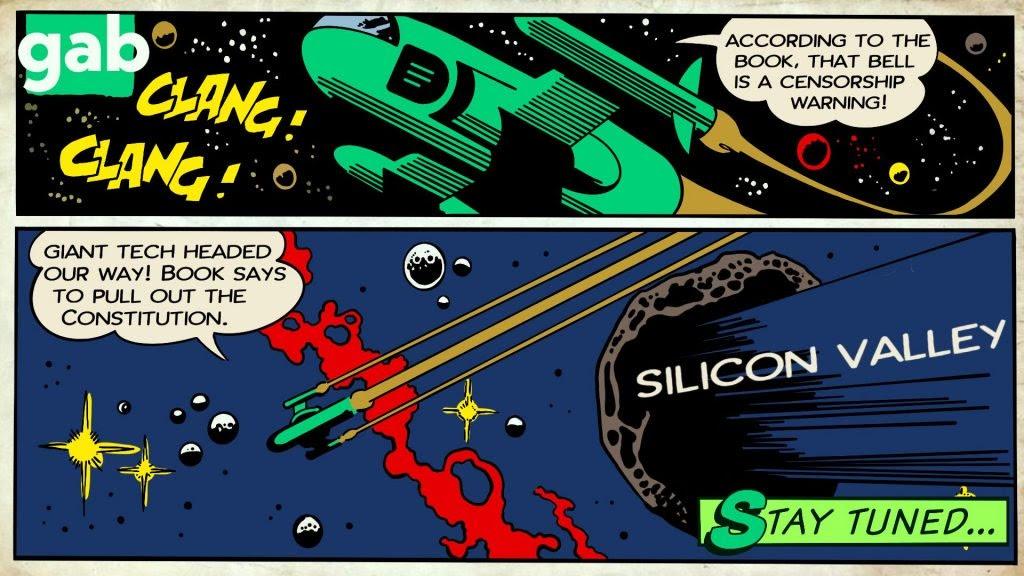
“The growth of online platforms in recent years raises important questions about applying the ideals of the First Amendment to modern communications technology. Today, many Americans follow the news, stay in touch with friends and family, and share their views on current events through social media and other online platforms. As a result, these platforms function in many ways as a 21st century equivalent of the public square.
“Twitter, Facebook, Instagram, and YouTube wield immense, if not unprecedented, power to shape the interpretation of public events; to censor, delete, or disappear information; and to control what people see or do not see.
“As President, I have made clear my commitment to free and open debate on the internet. Such debate is just as important online as it is in our universities, our town halls, and our homes. It is essential to sustaining our democracy.
“Online platforms are engaging in selective censorship that is harming our national discourse. Tens of thousands of Americans have reported, among other troubling behaviors, online platforms “flagging” content as inappropriate, even though it does not violate any stated terms of service; making unannounced and unexplained changes to company policies that have the effect of disfavoring certain viewpoints; and deleting content and entire accounts with no warning, no rationale, and no recourse.”
Gab has been making the most of the Twitter contratempt by rolling out the red carpet for the president, with an account that has already amassed over 37,000 followers.
The account has the same handle and profile picture as Trump’s Twitter account and is mirroring his Twitter posts without interference.
In an email sent to its members on Wednesday night, Gab said that it was “a historic day” for the social network and that it had “reached out to the Trump campaign to let them know that we have an account for the President.”
Gab has been criticised as a “fringe” platform, a far-right social network filled with conspiracy theories, racism and antisemitism.
Founder Andrew Torba is the former CEO of an advertising technology company called Kuhcoon. He was just 25 when he launched Gab back in 2017, saying as a conservative he felt out of place in Silicon Valley and became increasingly concerned about online censorship and political bias.
“Every major communication outlet, every major social network, is run, owned, controlled and operated by progressive leaders, progressive workers in Silicon Valley,” he said.
The site came to national prominence in 2018 when the suspect in the Tree of Life synagogue shooting in Pittsburgh posted an anti-Muslim screed on Gab hours before shooting and killing 11 people.
While Gab was taken offline in the aftermath of the shooting, it came back online soon after and has since thrived.
Here is message to Gab users Andrew Tobin wrote this week:
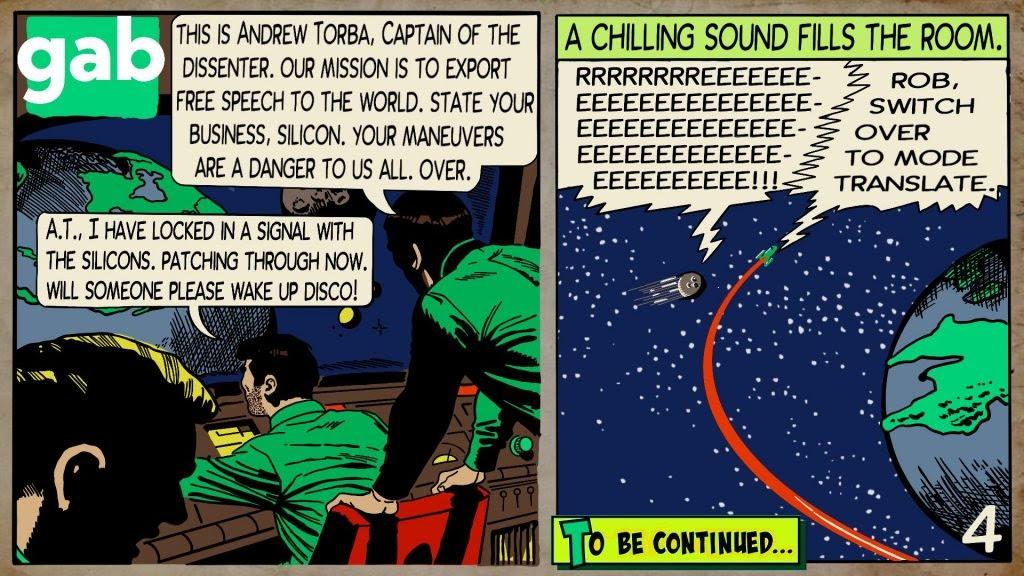
Gab is a free speech software company. We build open source software with the primary purpose of conserving and exporting the uniquely American value of free speech to the world online.
Our most popular product is Gab.com, our social media platform with millions of users from around the world. On Gab the rules are simple: if it’s legal speech, it’s allowed. Illegal content and activity is not allowed.
Gab also follows American privacy law in regards to protecting user data. We believe that privacy is a human right and that the dignity of a sovereign individual should be respected.
We don’t just say these things, we actively defend these values everyday. For example we regularly protect the privacy of international Gab users by turning down speech-related data requests.
On a regular basis foreign governments attempt to censor or no-platform individuals on Gab for “offensive” or “hateful” speech that is 100% protected by the first amendment and our user guidelines. We reject these requests and in doing so are exporting American freedoms to people all over the world on the internet.
We are also proud of our relationship with US law enforcement and the balance of due process, privacy, and free speech to keep criminal activity out of our community.
For over three years now the mainstream media and establishment players in the Silicon Valley cabal have smeared Gab because they do not share our values.
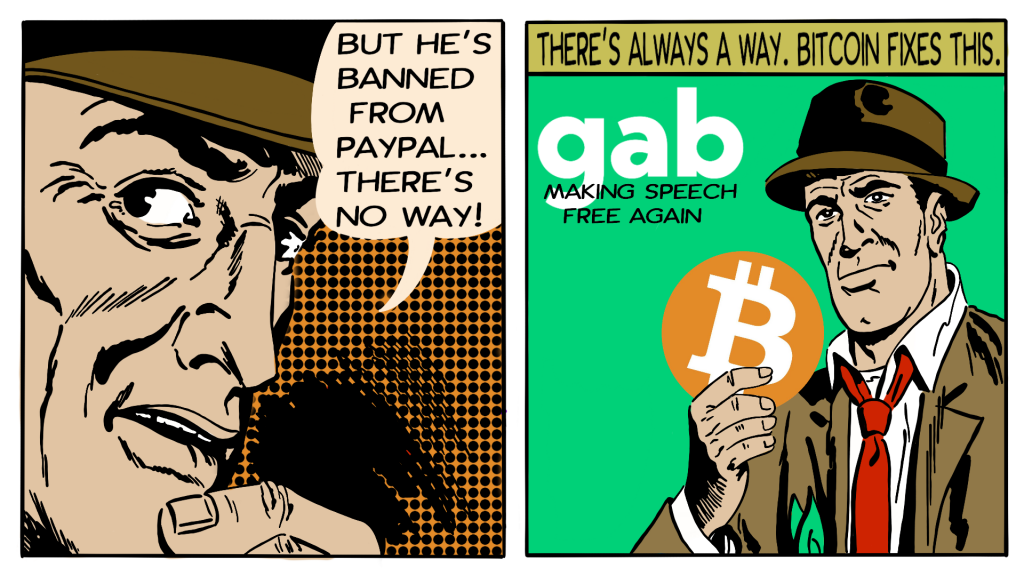
For holding the values described above, Gab has faced unique challenges on our journey. We have been no-platformed from dozens of service providers including both app stores, hosting providers, domain registrars, payment processors, and even banks. We’ve overcome these challenges by building our own infrastructure and by leveraging censorship-resistant technology like bitcoin.
The rise in the censorship of American citizens by American corporations and the subversion of democracy by those same US corporations is harrowing to me as a Christian American. Silicon Valley companies do not share my Christian values and indeed have a consistent history of silencing Christians online.
Free speech is at the forefront of the 2020 election. In just the past year we saw Democratic Presidential candidates and mainstream media personalities calling for Twitter to ban President Trump’s account.
Twitter then quickly announced that they will be removing the ability to like, reply, or repost President Trump’s tweets that are “abusive” according to their standards.
This isn’t “democracy” and it certainly isn’t “normal.”
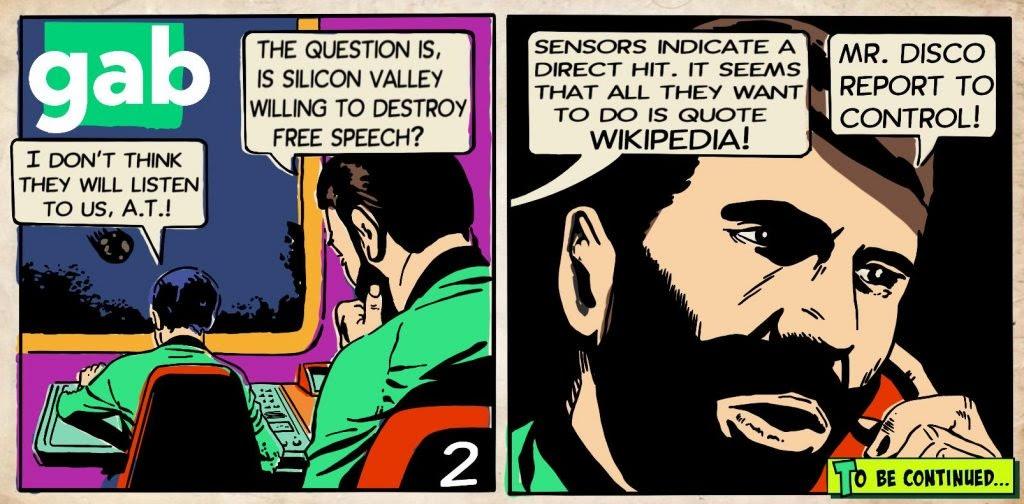
Big Tech’s unchecked power to dictate who can speak, who can make money, and who can exist online is only part of the bigger picture.
Big Tech is curating and editorializing the legal political speech of American citizens and limiting the reach and engagement of the President of the United States.
Big Tech is socially engineering the American electorate.
Studies have shown that biased Google search results can swing and influence elections. Facebook has admitted to conducting psychological experiments on users. Facebook is building a literal mind reading device. Google was working with China to build a censored search engine. Pinterest censored pro-life and Christian content from their site.
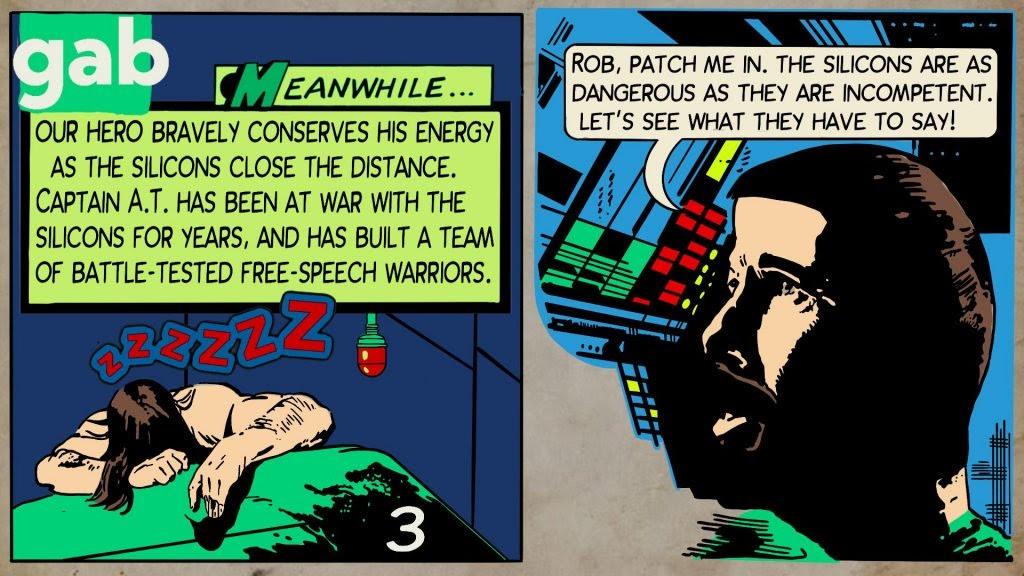
Silicon Valley’s bravado has also inspired the Chinese government to project their values of censorship, communism, and control on millions of Americans online.
Many of the top mobile game and mobile apps are owned and controlled by the Chinese. Apps like Tiktok have already censored content that criticizes the Chinese government, but not just in China. They are doing it to Americans too.
These two versions of the internet are different sides of the same tyrannical coin. This corporate or foreign state-controlled internet isn’t the internet I want my daughter to grow up with. This isn’t the internet the people of the world deserve.
On Gab users are not the product, they are the customer. Gab monetizes by selling an optional service called GabPro. For the cost of a cup of coffee every month, GabPro users can get verified and unlock additional features.
We also offer a free speech browser that automatically blocks all Big Tech ads and trackers. The browser includes a universal comment section across the entire internet. Users can comment on any URL and also see what others are commenting.
What we all need to realize is that together we vastly outnumber Silicon Valley. They only control us only as long as you and I continue to let them do it. I refuse to allow it any longer.
Written and compiled by John Stapleton, editor of A Sense of Place Magazine. A collection of his journalism can be found here.

TODAY’S FEATURED BOOKS