Saturday, 3 January 2009

Fear ever present but future not so Bleak, Weekend Australian, 3 January, 2009.

Fear ever present but future not so Bleak

Stapleton, John. Weekend Australian [Canberra, A.C.T] 03 Jan 2009: 8.
Show highlighting
For The Australian and The Weekend Australian's cartoonist Bill Leak, the idea for today's cartoon came right on schedule -- at 10.30am yesterday, just before the paper's morning news conference.
"The doctors have warned me that I will discover I can't do things I have always taken for granted," Leak said. "I live in quiet expectation of finding out what those things are. It is awful. It is a fear something is going to be taken away."
Leak still looks at ease as he sketches rapidly. "The drawing is pure pleasure," he said. "But cartoons are more than just about drawing, they are visual concepts.

Original Copy, Bill Leak Story, written in car on way back, The Australian, 3 January, 2009.


Friday, 2 January 2009

Grin and bear it: private schools lift fees The Australian 2 January 2009 Additional Reporting

Grin and bear it: private schools lift fees

THE cost of a private school education will soar this year, with some of the nation's top schools increasing their tuition fees at a time when household budgets are tightening.
Despite receiving $28 billion from the federal Government over the next four years, private schools are raising their fees by an average of 7 to 8 per cent, andby as much as 14 per cent in some cases.
The most expensive school in the nation is Geelong Grammar in Victoria, which this year will charge parents almost $29,000 for a Year 12 student.
The fee of $28,886 is a rise of 8per cent on last year and comes on top of about $200,000 the school raised last year from parents and the community in its "annual giving" fundraising effort.
The schools charging the highest fees are independent schools, mostly Anglican, in NSW and Victoria.
Many of the elite schools in those states are charging more than $20,000 a year in Year 12.
Schools blame the fee rises on increases in teachers' salaries, which account for 65 to 80 per cent of a school's costs, and increased paperwork as a result of greater accountability and information demanded by the federal Government.
While firm numbers on whether fees have affected enrolments are not yet available, anecdotally parents are reporting that the tough economic climate is causing them to reconsider.
Having already noticed a drift from the private system to public schools, Kate Cooper, principal of Mosman Public School in the heart of Sydney's wealthy north shore, told The Australian yesterday that she expected the movement to grow this year, partly as a result of the global financial crisis.
"If the chips are down, you are going to make a decision about value for money, and I don't believe parents are getting value for money in the private system," Ms Cooper said.
However, many parents who send their children to private schools are not prepared to cut costs by taking their children out of them.
Roxanne Gorman, who pays $40,000 a year to send her two daughters to private schools, said she would not skimp on the cost of her children's education.
Ms Gorman, 44, from Sydney's eastern suburbs, sends her daughter Neve Campbell, 13, to SCEGGS Darlinghurst, and her other daughter, Constance Campbell, 15, to The McDonald College, a performing arts school in the city's inner west.
Having recently divorced, Ms Gorman said that despite the fee hike, she was not prepared to opt for the public system. "It's hard yards for me, but I think it would be too turbulent on the girls to pull them out," said Ms Gorman, who is a financial adviser.
Ms Gorman, who was educated at public schools, said there was a perception that government schools were underfunded and offered inferior schooling, whereas private schools such as SCEGGS offered better conditions.
"The class sizes are smaller and the standard of education is better," she said. "Whatever your child's strengths are, the teachers are capable of drawing it out and improving on it."
Not all schools have revealed their 2009 school fees, but among the highest charging is Ascham, a girls' school in Sydney's eastern suburbs, which will increase fees by 7 per cent to $24,600 for Year 12 students this year. The inner-Sydney girls' school SCEGGS Darlinghurst is not far behind, charging $24,413 in Year 12, an 8 per cent rise.
In Melbourne, Lauristone Girls School in the eastern suburb of Armadale has one of the largest increases, 14 per cent, to $21,980. Parents with teenagers at Trinity Grammar School, a boys' school in Kew in eastern Melbourne, face an 11per cent fee rise to $19,240 in Year 12, said to be the biggest jump there in a decade.
Schools charging more than $20,000 this year for students entering Year 12 in Sydney include PLC Croydon and Newington in the inner west; The King's School in the west; Saint Andrew's Cathedral School and Sydney Grammar School in the CBD; Cranbrook, Reddam House, Ascham, SCEGGS Darlinghurst in the east; and SCECGS Redlands, Ravenswood and PLC Pymble in the north.
In Victoria, schools charging annual fees of more than $20,000 include Melbourne Grammar and Melbourne Girls Grammar in the city; St Catherine's, Scotch College and Hailebury in the east; and Geelong Grammar.
In Queensland, independent schools expect fee rises of an average 4 per cent, with the highest fees charged at Brisbane Girls Grammar of $14,980 and the Anglican Church Grammar School of $14,140 in Year 12.
In Western Australia, fees are touted to break the $17,000 mark for the first time, with Christ Church Grammar charging $17,560 and MLC at Claremont just above $17,000. The Hale School at Wembley Downs will charge $16,500 and St Hilda's Anglican School at Mosman Park $16,100. In South Australia, the most expensive fees for Year 12 are at Prince Alfred College at $15,117, St Peter's Girls School at $14,860 and Pulteney Grammar at $14,610. Schools blame the fee rises on increases in teachers' salaries.
Government teachers in WA and Victoria won large pay rises this year, which influences the amount paid in the private sector. Victorian teachers at the top of the scale receive an extra $10,000, with an annual salary of $75,500, while beginning teachers were given a pay rise of $5000 to $51,184.
On average, About 60 per cent of an independent school's income is garnered from parents, with the federal Government providing 30 per cent and state and territory governments 10 per cent.
Additional reporting: John Stapleton

Grin and bear it: private schools lift fees, The Australian, 2 January, 2009. Additional reporting. Page One.

Grin and bear it: private schools lift fees

Ferrari, Justine, Lex Hall, Additional Reporting John Stapleton, The Australian [Canberra, A.C.T] 02 Jan 2009: 1.
Show highlighting
Not all schools have revealed their 2009 school fees, but among the highest charging is Ascham, a girls' school in Sydney's eastern suburbs, which will increase fees by 7 per cent to $24,600 for Year 12 students this year. The inner-Sydney girls' school SCEGGS Darlinghurst is not far behind, charging $24,413 in Year 12, an 8 per cent rise.
Schools charging more than $20,000 this year for students entering Year 12 in Sydney include PLC Croydon and Newington in the inner west; The King's School in the west; Saint Andrew's Cathedral School and Sydney Grammar School in the CBD; Cranbrook, Reddam House, Ascham, SCEGGS Darlinghurst in the east; and SCECGS Redlands, Ravenswood and PLC Pymble in the north.
In Western Australia, fees are touted to break the $17,000 mark for the first time, with Christ Church Grammar charging $17,560 and MLC at Claremont just above $17,000. The Hale School at Wembley Downs will charge $16,500 and St Hilda's Anglican School at Mosman Park $16,100. In South Australia, the most expensive fees for Year 12 are at Prince Alfred College at $15,117, St Peter's Girls School at $14,860 and Pulteney Grammar at $14,610. Schools blame the fee rises on increases in teachers' salaries.

Party rolls on as New Year dawns, The Australian, 2 January, 2009.

Party rolls on as New Year dawns

Stapleton, John. The Australian [Canberra, A.C.T] 02 Jan 2009: 3.
Show highlighting
"It's a good feeling to be able to come here each year, reflect, tick off last year's resolutions and think of some new ones," Ms [Randal Huntington] said.
Assistant Commissioner Catherine Burn said: "The arrest figures are a positive result when you consider the numbers of people celebrating the New Year in Sydney's CBD, as well as in suburbs throughout the metro area."
"It was the quietest New Year's Eve and New Year's Day celebrations on record," Mr [Gary Jamieson] said.

Thursday, 1 January 2009

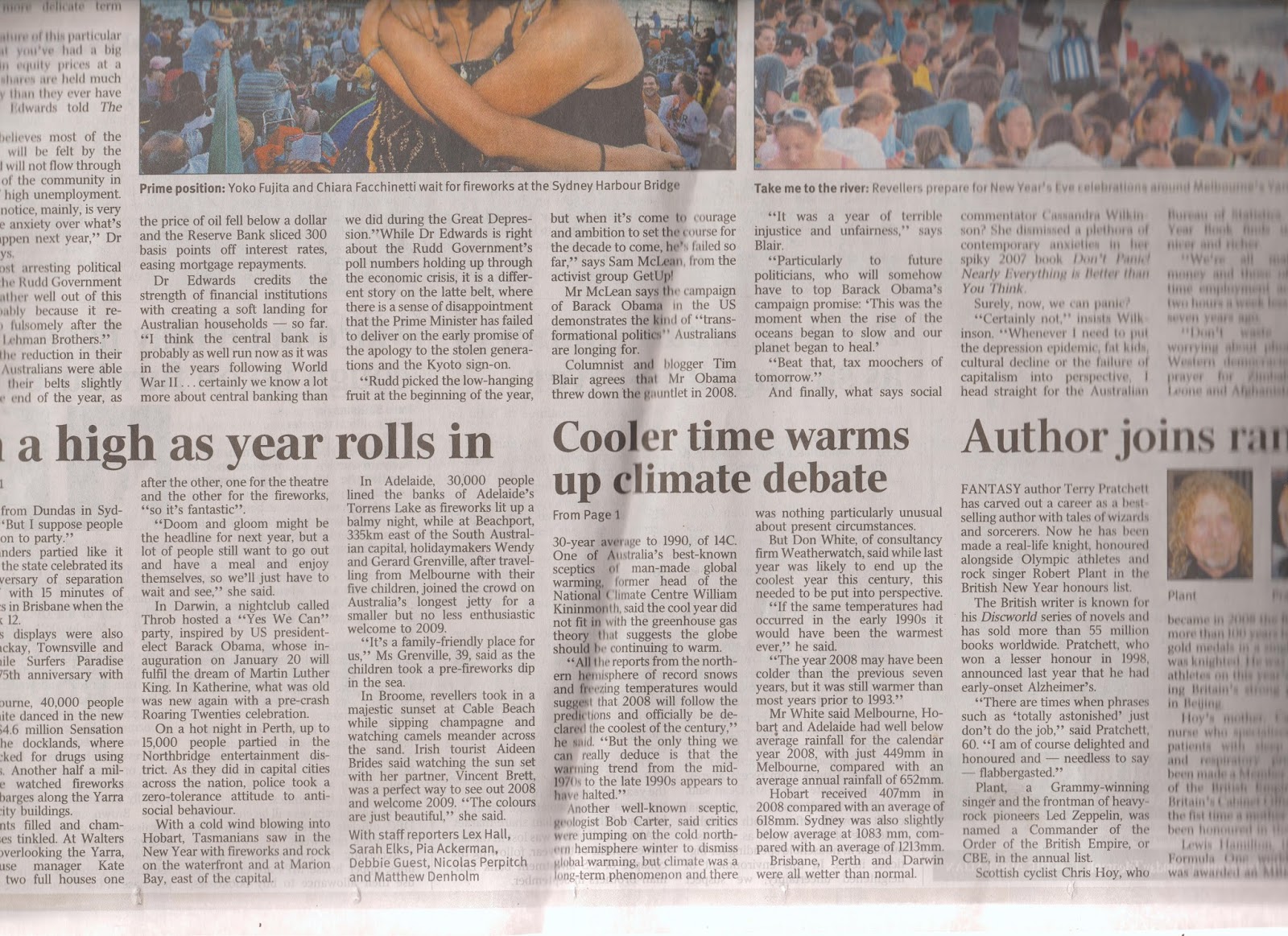
Cool 2008 warms climate debate, The Australian, 1 January, 2009. Page One.

I got more hate mail over these stories, which I was asked to do by a senior editor, than almost anything else I have ever written. The story was just straight reportage. Considering the global warming alarmists, with their billions of dollars in funding were taking up almost all of the available media space and sceptics were routinely ridiculed and howled down, it was ridiculous.
The fact that a straight forward issue like climate was seized upon by political activists and discussion and dissent was routinely shut down by the thuggery of group think has contributed significantly to the poor quality of contemporary debate and the shift to the right.


Cool 2008 warms climate debate

Stapleton, John. The Australian [Canberra, A.C.T] 01 Jan 2009: 1.
"Since 1990, the Australian annual mean temperature has been warmer than the 1961-1990 average for all but two years, 2008 being one of those years," he said.
"All the reports from the northern hemisphere of record snows and freezing temperatures would suggest that 2008 will follow the predictions and officially be declared the coolest of the century," he said. "But the only thing we can really deduce is that the warming trend from the mid-1970s to the late 1990s appears to have halted."
"The year 2008 may have been colder than the previous seven years, but it was still warmer than most years prior to 1993."

Full Text